As the curtain falls on Miami Art Week 2025, the city remains electric with the afterglow of a week that pushed the boundaries of functional art. While the sprawling tents of Art Basel offered their usual blue-chip brilliance, the true pulse of the week was felt in the experimental design installations that transformed Miami’s sun-bleached vernacular into a playground of materiality. From Es Devlin’s rotating literary monument on the sands of Faena Beach to the slime-green carpets and metallic walls of historic villas, the “Dezeen Selects” from this year prove that design in 2026 is no longer just about form following function—it is about belief, memory, and an unapologetic embrace of the surreal.
The Monumental: Es Devlin’s Library of Us
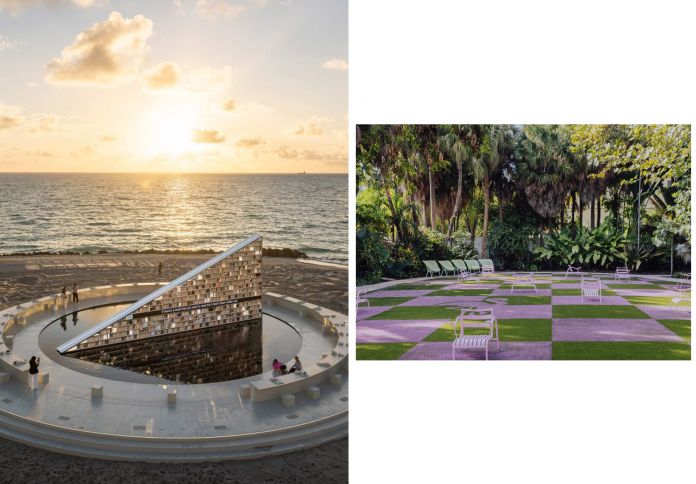
The most talked-about installation of the week was undoubtedly Es Devlin’s “Library of Us.” Situated directly on the sands of Faena Beach, this 50-foot-tall revolving library functioned as a giant sundial and a public reading room. The structure took visitors on a literal spin through the 17th-century courtyard of the Pinacoteca di Brera (in spirit), perusing over 3,000 books chosen to reflect the theme “Thought for Humans.”

The installation wasn’t just a visual landmark; it was an interactive experience that encouraged a slower pace amidst the frantic energy of Art Week. By allowing readers to view the surrounding sculptures from shifting angles as the platform rotated, Devlin created a space where literature and landscape merged. It served as a poignant reminder of the enduring power of the physical book in an increasingly digital world.
Experimental Living: Alcova Miami at the River Inn
Returning for its third iteration, the experimental design showcase Alcova took over the historic Miami River Inn. The oldest hotel in the city became a whimsical wonderland where designers were asked to fill the rooms with avant-garde visions. The entrance featured a striking pink-metal desk by Present Forms, leading into a courtyard decked out in a hot-pink checkered carpet by Patricia Urquiola and manufacturer Haworth.

Standouts from the multi-building installation included a rubber-lined room by Ombia Studio and flat-pack metallic furniture by Vincent Laine. The showcase successfully demonstrated how design thrives when architecture is an active companion rather than a neutral backdrop. By repurposing a haunted, storied locale, Alcova solidified its reputation as the go-to destination for those looking for the “next” in collectible design.
The Design Miami Milestone: A 20th Anniversary Rebirth
Design Miami celebrated its 20th anniversary with the theme “Make Believe,” curated by Glenn Adamson. The fair eschewed the typical “minimalist beige” for a bold, tropical energy. Highlights included the first standalone furniture line by architecture studio Arquitectonica and the “Best New Voice” winner, Gallerie Signé, which brought a crisp, industrial French aesthetic to the tent.

A major trend this year was the reimagining of traditional textiles through industrial materials. Stephen Burks Man Made, in collaboration with Alpi, created “The Lost Cloth Object”—a speculative ceremonial site that used wood to recreate Congolese Kuba textile patterns. This fusion of ancient craftsmanship and modern manufacturing highlighted the fair’s focus on “material storytelling” and the emotional grounding of well-crafted surfaces.
The Future Perfect: Little Haiti’s New Outpost
Design gallery The Future Perfect opened its first Miami outpost inside Villa Paula, a storied 1920s residence in Little Haiti. The exhibition was a masterclass in curation, placing contemporary pieces within a domestic setting that felt both historic and futuristic. One of the most striking rooms featured metallic walls and slime-green carpet, where a red cabinet by Orior sat beside a mosaic table by D-Haene Studio.

This move into Little Haiti reflects a broader trend of design moving away from the South Beach “tent culture” into the city’s diverse neighborhoods. The installation used the building’s rumored haunted history to create an atmospheric, liminal realm where “form becomes fiction.” For many, the “Villa Paula” experience was the definitive proof that Miami’s design scene has matured into a year-round cultural powerhouse.
The Sensory and the Sustainable: 3D Printing and Light
Material innovation was at the forefront of the week’s off-site projects. Pininfarina showcased an expressive pavilion at Alcova that 3D-printed discarded tires into a structural bridge between emotion and computation. Meanwhile, Pilar Zeta’s “The Observer Effect” at The Shelborne By Proper featured an iridescent, monumental sculpture that invited visitors through portals fusing nature and architectural space.

These installations pointed toward a 2026 design vocabulary that prioritizes sustainability without sacrificing the “pastel-hued tropical fever dream” that defines Miami. Whether it was Rivian’s “Rewilding the Future” light show or IKEA’s Open House Miami, the message was clear: the future of design is tactile, vivid, and deeply connected to the environment—even when that environment is a high-tech art fair.
The Legacy of Miami Art Week 2025
As the 2025 review of the week concludes, the “Design Selects” highlight a shift toward “collectible design” that prompts a smile. The rise of self-assured, joyful aesthetics has provided an alternative to the repetitive results of function-first mentalities. Miami Art Week has once again proven that design is a tool for betterment and positive change, turning the city into a living laboratory for the “Make Believe.”