As 2025 draws to a close, the architectural world is looking far beyond the immediate horizon. While the year was defined by the completion of massive projects like New York’s 270 Park Avenue, the truly “internet-breaking” moments came from the unveiling of future blueprints. From a literal kilometre-high tower in the desert to a curving glass bridge in Australia, the announcements of 2025 represent a renewed appetite for the monumental and the impossible. As we enter 2026, these ten projects stand as the most significant signals of where humanity intends to build next—balancing a return to supertall ambition with an increasingly desperate need for ecological integration.
The Return of the Kilometre: Jeddah Tower, Saudi Arabia
After years of stalled construction and silence, the Jeddah Tower (formerly known as Kingdom Tower) officially re-entered the global conversation in 2025. Designed by Adrian Smith + Gordon Gill Architecture, the project has resumed with the explicit goal of becoming the world’s first structure to reach at least one kilometre (3,281 feet) into the sky.

The announcement that construction has been fast-tracked for a 2028 completion has reignited the “supertall race” in the Middle East. With its sharp, aerodynamic “three-petal” footprint, the tower is designed to withstand extreme wind loads at heights previously thought unattainable. In 2026, the Jeddah Tower isn’t just a building; it is a symbol of Saudi Arabia’s “Vision 2030” and a direct challenge to the Burj Khalifa’s long-held record.
Sky-High Connectivity: One Park Lane, Australia
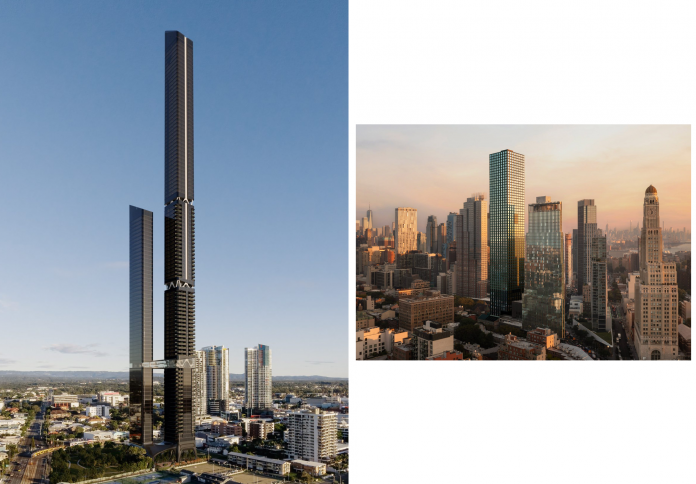
Australia made waves in July 2025 with the proposal for One Park Lane, a pair of skyscrapers on the Gold Coast that would reshape the continent’s skyline. Designed by BKK Architects with refinement from Cottee Parker, the taller of the two residential towers is set to rise to 382 metres, which would make it the tallest building in Australia.

The project’s most distinctive feature is a curving glass bridge located 22 storeys above the ground, linking the two towers and providing residents with a dramatic, sky-high social hub. By surpassing other recent proposals in Melbourne and the existing Q1 Tower, One Park Lane signals the Gold Coast’s evolution into a high-density, vertical metropolis that rivals major Asian hubs for architectural audacity.
The Loop of Culture: Suzhou Museum of Contemporary Art
In China, BIG (Bjarke Ingels Group) unveiled the final designs for the Suzhou Museum of Contemporary Art. The project is envisioned as a series of interconnected, stainless-steel “ribbons” that loop across the site, creating a fluid, non-linear journey for visitors. The design is inspired by the traditional scholar’s gardens of Suzhou, reimagined through a 21st-century lens of digital geometry and industrial materials.

The museum is part of a larger push in 2025 to create “sculptural landmarks” that serve as community hubs rather than just repositories for art. The “loop” design ensures that the building has no clear front or back, encouraging a 360-degree interaction with the surrounding parkland. As of early 2026, the Suzhou Museum is already being hailed as BIG’s most poetic work in Asia to date.
Sustainable Gateways: Gelephu International Airport, Bhutan
Perhaps the most ethically significant announcement of 2025 was the reveal of the Gelephu International Airport in Bhutan, also designed by BIG. As part of the “Mindfulness City” masterplan, the airport is designed to be the world’s first “carbon-negative” international gateway. The structure incorporates massive timber “trees” that support a wide-span roof, mimicking the lush, mountainous topography of the Himalayas.

The airport will feature a series of bridge-like terminals that span across local rivers, integrating water management and biodiversity corridors directly into the infrastructure. This project represents a radical shift in how we conceive of aviation hubs—not as isolated concrete islands, but as permeable extensions of the natural landscape. In 2026, Gelephu stands as the definitive blueprint for “regenerative” infrastructure.
The Urban Forest: Saudi Arabia Pavilion at Expo Osaka
Looking ahead to the grand opening of the World Expo 2025 in Osaka, Foster + Partners released the final details for the Saudi Arabia Pavilion. Rather than a traditional building, the pavilion is designed as an “abstract forest” composed of sculptural, polygonal volumes. The layout recreates the intimate, winding pathways of a traditional Arab village, translated into a futuristic, low-carbon material palette.

The design emphasizes the “overlap between the organic and the artificial,” featuring neither traditional walls nor a roof in certain sections. Instead, it relies on a data-network-inspired canopy that provides shade while allowing for natural ventilation. This announcement underscored the theme of the 2025 Expo—reimagining human connection in a post-digital world—and has become the most anticipated pavilion of the upcoming event.
The Legacy of 2026: A Blueprint for Resilience
The building announcements of 2025 reveal a collective realization that architecture must now do more than just house people; it must heal the environment or provide extreme density to protect it. We are seeing a “splitting” of architectural trends: on one hand, the pursuit of the kilometric supertall in Saudi Arabia and Australia; on the other, the timber-based, biophilic restoration seen in Bhutan and China.

As these ten projects move from render to reality throughout 2026, they will test the limits of our engineering and our ethics. Whether it is the sheer verticality of the Jeddah Tower or the mindfulness of Gelephu, the buildings announced this year are more than just steel and stone—they are the physical manifestos of our future.