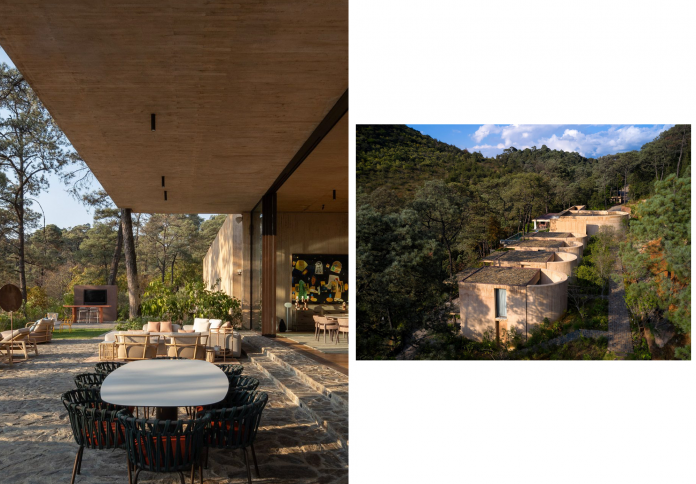
In the iron-rich hills of Valle de Bravo, a new vacation residence has emerged that challenges the monolithic nature of the modern “ranch.” Completed in late 2024 and gaining international acclaim throughout 2025, “Rancho del Bosque” is a 735-square-meter exercise in architectural fragmentation. Designed by the renowned studio Sordo Madaleno Arquitectos, the home is divided into six distinct concrete pavilions, each nestled into a steep pine forest slope. By opting for a series of smaller footprints rather than a single large volume, the architects have created a “stroll through the forest” where the home’s interior and the wild landscape are in constant, vibrant tension.
Topographical Poetry: Anchoring the Hillside
The design of Rancho del Bosque (Forest Ranch) began with a commitment to the land. Located in a mountainous region west of Mexico City, the site is defined by a 20,000-square-meter expanse of pine forest and significant elevation changes. Rather than flattening the terrain, Sordo Madaleno chose to work with the natural gradient. The six structures are arranged in a neat row along a single horizontal axis, meticulously positioned to conserve the tall, existing pine trees.

By breaking the overall volume of the ranch into modules, the architects have softened the building’s impact on its environment. Each pavilion “rests gently” on the hillside, utilizing suspended terraces and stone pathways to bridge the gaps between the concrete volumes. This fragmented layout forces residents to step outside as they move between functions, turning the simple act of going to bed into a sensory journey through the crisp, mountain air.
The Materiality of Iron: Red Pigmented Concrete
Visually, the house is a direct extension of the earth. Sordo Madaleno utilized pigmented concrete with a subtle reddish hue, specifically chosen to match the iron-rich soil of Valle de Bravo. This choice ensures that the architecture does not fight against its backdrop but instead feels like a geological outcropping. The rough texture of the concrete, marked by the wooden formwork, is paired with local stone and timber to create a palette that is both brutalist and warm.

The geometry of the pavilions is equally striking. Five of the blocks take the shape of extruded semi-cylinders, with simple, bold, curved elevations facing the mountain. This design serves a dual purpose: it creates a sense of “safe enclosure” against the wild forest while alluding to traditional defensive rural structures. The curved stone walls within these volumes conceal service spaces, keeping the primary living areas open and uncluttered.
A Program in Parts: Living, Sleeping, and Service
The internal program of the home is distributed logically across the six structures. The largest block serves as the Social Pavilion, featuring a double-height living and dining space. Its north elevation is entirely glazed with sliding glass doors that open the interior to a slender lap pool and hot tub. To the south of this social hub are four smaller blocks:
- Lounge Pavilion: A cozy, intimate space for relaxation.
- Three Bedroom Pavilions: Organized over two floors, these pavilions provide secluded sleeping quarters, with each room featuring its own balcony and views over the valley.
At the northernmost end sits a cuboidal sixth block, which houses the kitchen, laundry, and staff quarters. This “Service Wing” is functionally separated from the rest of the residence, ensuring privacy for both the owners and the support staff while maintaining the home’s overall aesthetic continuity.
Blurring the Boundaries: The External Circulation
The true heart of Rancho del Bosque is the space between the buildings. The circulation has been conceived as a forest stroll, with stone pathways and raised mountain-side walkways connecting the pavilions. This design plays on the Mexican tradition of open-air courtyard living, but adapts it for the rugged topography of the forest. The distinguishing line between “inside” and “outside” is intentionally blurred, with floor-to-ceiling pivot doors allowing the scent of the pines to carry throughout the rooms.

In late 2025, Rancho del Bosque was highlighted as a masterclass in “passive immersion.” By orienting the house toward the north vistas and using the thermal mass of the concrete to regulate temperature, the home achieves a high level of environmental performance without compromising its bold, sculptural identity. It is a home that balances human intent with natural continuity, offering a “secluded relationship” with the wilderness.
The Legacy of 2026: Architecture as Landscape
As we settle into 2026, Sordo Madaleno’s work in Valle de Bravo—including this project and the award-winning Valle San Nicolás Clubhouse—has established a new vernacular for Mexican rural luxury. Rancho del Bosque proves that a ranch does not have to be a closed fortress. Instead, it can be a series of “pavilions in the trees,” where the architecture rests nestle into the hills rather than dominating them.

The success of the project lies in its restraint. In an age of over-building, Sordo Madaleno has provided a template for how to live in nature without displacing it. The “forest ranch” is more than a vacation home; it is a permanent dialogue between the stone we carve and the trees we protect. In the silence of Valle de Bravo, the red concrete of the pavilions speaks a language that both the earth and its inhabitants can understand.