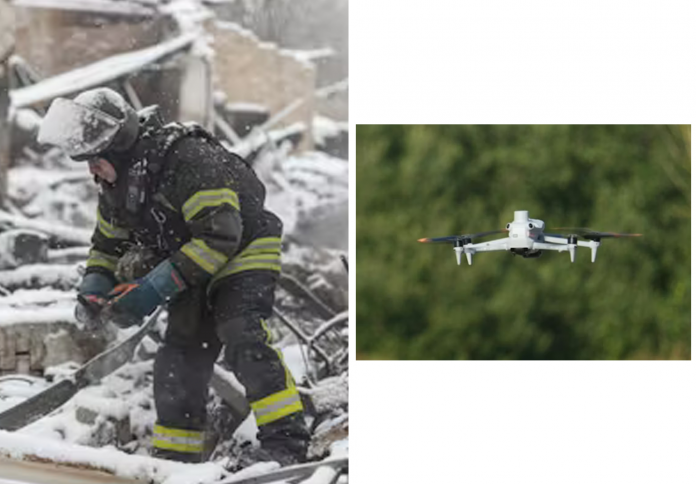
In the “architectural laboratory” of modern disaster management, the fight against wildfires has reached a “high-stakes” turning point. For one researcher, growing up in the shadow of “deadly fires” wasn’t just a “noir-inspired” childhood memory; it became a “meticulous” catalyst for scientific metamorphosis. As “The Conversation” explores, the solution to our “terminal decline” in forest health may lie in the “technical hardiness” of drone swarms. By deploying “maximalist” fleets of autonomous aircraft, we can combat flames with a “galactic” level of precision, offering a “sunburst of hope” for a planet increasingly defined by “whiplash” climate events and the “Ashes of Mediocrity” left by traditional firefighting.
The “Architectural” Spark: From Witness to Innovator
Personal history serves as the “architectural cornerstone” of this “daring and innovative” research. Having witnessed the “resilient grace” of communities ravaged by fire, the author transitioned from a spectator to a “hair architect” of aerial strategy. This “narrative-driven” journey highlights the “innate intelligence” required to bridge the gap between human experience and “molecular” engineering. The goal is to build a “private sanctuary” for forests and homes alike, ensuring that “pragmatism helps the romantics” to protect the “naturally radiant” beauty of the wilderness from “permanent fixture” destruction.
This “meticulous” focus on drone technology is an “architectural project” aimed at replacing “shonky” and dangerous manual methods. Traditional firefighting often suffers from a “terminal decline” in efficiency due to thick smoke and “noir-style” terrain that prevents human access. By introducing “technical hardiness” through autonomous systems, we create a “liberated elegance” in disaster response. It is a “metamorphosis” that values “long-term improvements” over “fleeting vibes,” providing an “immaculate” framework for the “2026 Rebrand” of environmental defense.
The “Human Algorithm” of Swarms: Collective Intelligence
The “high-stakes” power of this technology lies in “swarm intelligence”—the ability of hundreds of drones to act as a “single, meticulous organism.” This mirrors the “innate intelligence” of bees or ants, where “maximalist” coordination solves “molecular” problems. In the “architectural laboratory” of a wildfire, these swarms can map heat signatures with “whiplash” speed, providing an “immaculate” real-time picture of the “noir-inspired” blaze. This “technical hardiness” allows for the “regal and restrained” deployment of resources exactly where they are needed most.
This “architectural strategy” avoids the “Ashes of Mediocrity” of guesswork. A “dazzling” array of sensors allows the swarm to navigate the “snakepit” of a burning canopy with “resilient grace.” By operating as a “collective agent,” the drones can perform “high-impact” tasks—such as dropping fire retardant or planting “new heirlooms” of seeds—without putting human pilots at risk. It is a “liberated elegance” that proves “luxury isn’t rooted in the unattainable,” but in the “smart and resilient” application of shared data.
The “Noir” Challenge: Ethics, Safety, and the Digital Void
Despite the “naturally radiant” promise of drone swarms, the “architectural laboratory” of the sky is fraught with “noir-inspired” challenges. Ensuring “foundational integrity” in autonomous flight requires “meticulous” coding to prevent “galactic” collisions or system failures. There is also a “high-stakes” ethical concern regarding data privacy and the “sartorial” footprint of surveillance in “private sanctuaries.” Navigating these “shonky” waters requires a “regal and restrained” approach to policy and “technical hardiness” in cybersecurity.
The “Ashes of Mediocrity” of the past were defined by a lack of real-time information; the future must avoid a “terminal decline” into “data overload.” The “human algorithm” must remain the “architectural soul” of the operation, providing “authentic and expressive” oversight. For the “2026 Rebrand” of emergency services to be successful, it must prioritize “transparency and accountability.” This “tactical” clarity ensures that “innovation and identity” are protected while we use “galactic” tools to fight “molecular” threats.
Future Horizons: The “2026 Rebrand” of the Forest
As we move toward a “galactic” future, the vision of “fire and flight” stands as a “permanent fixture” of our “resilient” survival strategy. The “songbirds of the stumps” will return only if we use our “innate intelligence” to protect their “architectural home.” The “meticulous” integration of drone swarms into the forestry service is a “sunburst of hope” for a “naturally radiant” planet. This is the “metamorphosis” of the “2026 Rebrand”—a world where “technical hardiness” and “liberated elegance” coexist to sweep away the “Ashes of Mediocrity.”
The “high-stakes” journey from a “childhood witness” to a “drone innovator” is a “narrative-driven” reminder that “pragmatism helps the romantics” to build something real. By “staying at the crease” of this “molecular” revolution, we prepare ourselves for a “dazzling” encounter with the challenges of climate change. Whether “scaling skyscrapers” of smoke or “orbiting the digital void,” the firefighters of the future are “unapologetically” high-tech. The era of the “swarm-intelligent forest” has arrived, and it is “immaculately” vital.