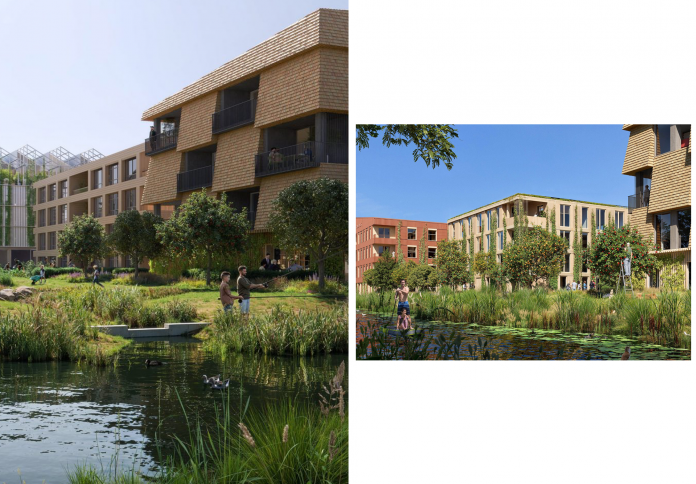
In the verdant polders of Hoofddorp, just 20 kilometers southwest of Amsterdam, the future of European housing is taking a distinctly organic shape. Revealed in December 2025, “The Erven” is a massive 519-home residential development designed by Scandinavia’s White Arkitekter in collaboration with a powerhouse Dutch design team. Inspired by the historical farmsteads that once dotted the Haarlemmermeer landscape, the project eschews concrete for cross-laminated timber (CLT) and traditional insulation for straw and hemp. As we move into 2026, The Erven stands as a flagship for the Lincolnpark development, promising a “living ecosystem” where residents don’t just live near nature—they inhabit it.
The Farmstead Reimagined: Four Themed Courtyards
The architectural soul of the project lies in its name: The Erven, the Dutch word for “farmyards.” The 519 homes are organized around four distinct courtyards, each designed with a specific communal theme: Ontspan (Relax), Groei (Grow), Maak (Create), and Speel (Play). This layout breaks down the large-scale development into intimate, village-like clusters, fostering social resilience and a sense of neighborly belonging.

Lead architect Oskar Norelius describes the project as a contemporary interpretation of the local rural typology. By mimicking the clustered volumes and pitched roofs of traditional Dutch farms, the design maintains a human scale despite its density. These shared courtyards are not just for residents; they remain open to the wider Hoofddorp community, functioning as car-free “green lungs” for the neighborhood.
A Symphony of Biomaterials: CLT, Straw, and Hemp
The Erven is a masterclass in low-carbon construction. The primary structural frames are built from cross-laminated timber (CLT), a renewable material that sequester carbon dioxide. To further minimize the embodied carbon footprint, the timber-frame walls are insulated with high-performance bio-based materials, specifically straw and wood fiber.

The facades are a tactile collage of natural and reused materials. Depending on the courtyard, buildings are clad in wood, reed, hemp fiber, lime, or recycled aluminum. This diversity ensures that each of the four “erven” has a unique visual identity while maintaining a unified, earthy aesthetic. By prioritizing “breathable” materials, White Arkitekter ensures superior indoor air quality and thermal comfort for the 2029 move-in date.
Circular Foundations and Adaptive Design
Sustainability at The Erven begins below ground. The project integrates circular design principles into its very foundations, which utilize recycled concrete and gravel. The buildings are conceived as modular systems, allowing for future flexibility; apartments can be reconfigured or components disassembled and reused if the neighborhood’s needs change over the coming decades.

This “long-life, loose-fit” approach extends to the rooftops. Many of the buildings feature reed or timber shingles combined with extensive green roofs and solar panels. These systems work in tandem to support local biodiversity while generating renewable energy. In a unique nod to local wildlife, each block includes an “ecozolder”—a specialized attic floor designed specifically to provide habitats for local bird and bat species.
Zero-Emission Living: Mobility and Energy
The Erven is designed to be CO2-neutral over its lifecycle. The neighborhood is powered by a centralized sustainable energy system featuring heat and cooling recovery. Beyond the buildings themselves, the project addresses the “last mile” of sustainability through integrated mobility hubs. These hubs combine secure bike parking (for over 1,800 bicycles) with parcel delivery zones and shared electric vehicle stations, effectively removing cars from the residential heart of the site.

Walkable streets and pedestrian-only garden paths ensure that the neighborhood remains a quiet, safe environment for children and seniors alike. By prioritizing “soft mobility,” the design team—which includes SeARCH, Space&Matter, Atlas Architects, and DS Landschapsarchitecten—has created a blueprint for how high-density urban living can still feel like a walk through a meadow.
The Legacy of 2026: Timber-Led Urbanism
As construction preparations begin for the 2027 start date, The Erven is already being hailed as a model for timber-led urbanism in Europe. It represents a significant shift in the Dutch housing market, moving away from the “concrete-first” mentality toward a bio-based future. With a large proportion of the 519 units designated as affordable housing, the project proves that sustainable, high-design living isn’t just for the elite.
In the landscape of 2026, The Erven serves as a reminder that the most innovative solutions are often found by looking back. By combining the social wisdom of the traditional farmstead with the technical prowess of CLT and biomaterials, White Arkitekter has built a bridge to a greener, more communal way of life. The “Little Village” of Hoofddorp is ready to grow.