From deserted villages in the UAE to coral reefs beneath the Gulf, the graduating class of the American University in Dubai’s School of Architecture, Art and Design is reshaping architecture as a force of empathy, ecology, and empowerment. Their thesis projects, presented at the 2025 Senior Showcase, push beyond form and function—offering designs that are immersive, speculative, and socially urgent. These aren’t just buildings. They’re living systems, cultural interventions, and in some cases, edible experiences. Through speculative prototypes and site-specific interventions, students explored how architecture can restore ecosystems, uplift communities, and even taste like dinner. Under the guidance of professors Jose A. Carrillo and Mattia Gambardella, the ARCH 502 – Architectural Studio X course became a launchpad for experimental, purpose-driven design.
Reviving memory: storytelling through architecture
Faisal Osman’s project “Abandoned” confronts the eerie silence of Al Madam, a ghost village in the UAE consumed by desert sand. Rather than romanticize or erase its past, Osman proposes a careful reintegration—using passive cooling strategies, fragmented geometry, and local materials to preserve the narrative of abandonment. His intervention honors the poetics of ruin and won First Place and the Aedas Design Award.

In a similar spirit of cultural reclamation, Salwa Almutairi’s “The Dhow Museum” revives the boat-building heritage of Ajman. Her design frames storytelling as a tool for preservation, offering hands-on experiences in a space where maritime craftsmanship and tourism intersect. It’s architecture as archival memory—tactile, instructive, and essential.
Underwater healing and ecological repair
In “Corals,” Meera AlHawai shifts the architectural gaze beneath the sea. Using bio-concrete and biorock technologies, her design aids in coral reef regeneration while creating a habitat for marine biodiversity. The structure’s parametric surfaces mimic reef ecologies, allowing architecture to function as both infrastructure and organism. AlHawai received Second Place and the Faculty and Alumni Award, highlighting the growing importance of architecture in environmental restoration.

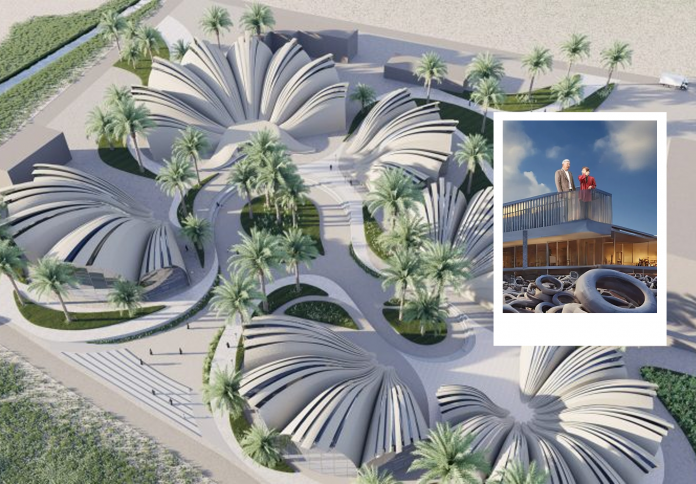
Another ecological standout is Aly Ahmed’s “Entropy,” which repurposes Kuwait’s massive tire graveyard into a hybrid art and recycling center. Turning waste into wonder, Ahmed’s design weaves environmental degradation into economic potential—an example of how architecture can upcycle the ignored into something culturally vital. His work was honored with the Compasses Magazine Award.
Rethinking the body: gender, wellness, and sensory space
Architecture isn’t just about shelter—it’s also about the human body. Few projects expressed this more viscerally than Nazanin Hosseini’s “Her,” set against the iron-rich terrain of Hormuz Island, Iran. Designed around the hormonal cycles of the female body, the project challenges patriarchal planning with an emotionally intelligent, biophilic architecture that prioritizes rhythm, privacy, and healing.
That thread of gender equity continues in Somaia Haggag’s “Veiled,” a 3D-printed housing solution for single mothers in rural Egypt. Drawing on traditional arch forms, Haggag’s design offers privacy and dignity within a flexible framework for community growth—more than housing, it’s a platform for social change.

Mahra AlEassa’s “Rooted” merges herbal medicine with sustainable design in a wellness center inspired by regional traditions. Her project doubles as a knowledge hub, integrating bioclimatic techniques and indigenous materials to create a space for physical and cultural healing.
Food as form: edible, educational, experimental
Few projects blended architecture with the senses like Dana Kharsa’s “Edible Arts,” a gastronomic learning center located in Abu Dhabi’s agricultural district. Her design frames architecture as a “spatial recipe,” where light, smell, sound, and materiality act as ingredients. Kharsa’s playful, heuristic design methodology won Third Place, reflecting a broader interest in sensory-driven learning environments.

In “Gastro-Genesis,” Dana Otoom pushes this idea further—creating edible objectiles and flavor-based algorithms that reshape the dining experience itself. Merging parametric design with molecular gastronomy, her speculative work asks: what if you could taste architecture?
Urban revival and regenerative systems
As cities grow denser and hotter, several students tackled sustainability through regenerative urbanism. Alia Almarri’s “Ecolíth” transforms the Dubai Police Academy into a living biomaterial campus. Using mycelium, algae, and erosion algorithms, her adaptive structures evolve with the environment—merging organic and built systems into a synthetic organism.
Shaam Guzlan’s “Verde Heights” responds to Dubai’s green deficit with a grounded, high-rise solution. Three vertical towers integrate urban farming, shading, and pedestrian pathways, restoring the human scale to a vertical city. This is architecture that restores the right to nature.

Public space also got a rethink in Lina Kataw’s “Sikkas in Bloom,” which transforms the alleys of Al Jaddaf into seasonal public gardens. Each sikka operates like a recipe—adaptive, community-driven, and open to reinterpretation over time.
Shelter, memory, and modular hope
Some of the most emotionally resonant projects addressed displacement and migration. In “Transendence,” Lena Zaher designed modular, tensile structures for refugee communities in Lebanon. Built to evolve with changing needs, her architecture offers more than shelter—it offers continuity, dignity, and a sense of belonging in times of crisis.
The same ethos drives many of this year’s projects: the belief that architecture is not an aesthetic luxury, but a tool for justice, ecology, and memory.
A manifesto for architectural activism
More than any specific site or structure, what unites these diverse projects is a shared ethos: architecture as an active, adaptive, and responsible discipline. Students moved fluidly between disciplines—combining urbanism with activism, ecology with emotion, food with form. And nearly every project aligned with one or more of the United Nations Sustainable Development Goals, part of an intentional institutional shift since COP28 in Dubai. This isn’t just the future of architecture—it’s a call to action. AUD’s 2025 cohort shows us that the architect of tomorrow is not just a designer, but a listener, a healer, a storyteller, and a changemaker.
About the program
These projects were developed as part of ARCH 502 – Architectural Studio X, the capstone studio course at the American University in Dubai’s School of Architecture, Art and Design, under the supervision of Jose A. Carrillo and Mattia Gambardella. The 2025 showcase represents a new generation of architects—research-driven, locally rooted, and globally aware.