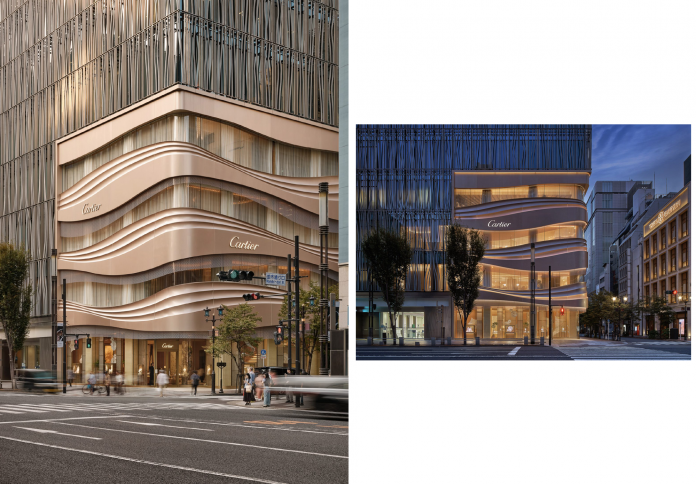
Amidst the high-octane glamour of Tokyo’s Ginza district, a new architectural presence has emerged that blurs the line between rigid construction and the fluid elegance of haute couture. Completed in late 2025, the new flagship facade for Cartier, designed by Klein Dytham architecture (KDa), is a bold experiment in materiality. By utilizing custom-cast aluminum to simulate the effect of a silky drape caught in a gentle breeze, the project brings a contemporary pulse to the French jeweler’s storied heritage. As we move into 2026, this facade has become a new landmark of Ginza, proving that even the most industrial materials can be rendered with poetic softness.
Inspiration from Jewelry Craft and High Fashion
The facade of Cartier Ginza draws its inspiration from two core elements: the meticulous craftsmanship of Cartier’s jewelry and Ginza’s long history as a global fashion epicenter. The architects at Klein Dytham architecture (KDa) sought to create a structure that didn’t just protect the building but “dressed” it in a magnificent garment. They chose the visual metaphor of a silk drape to guide the design, seeking to capture a sense of movement that feels entirely organic.

The “flow” of this aluminum fabric was carefully calculated to produce natural-looking pleats, offering a sense of lightness that contradicts the actual weight of the metal. According to the architects, the goal was to create a visual effect that shifts according to the viewer’s perspective, much like the way light dances across a finely cut gemstone in a Cartier collection.
Custom Aluminum Casting: From Rigid to Fluid
To realize this ambitious vision, KDa worked closely with metallurgical experts to develop specialized cast-aluminum components. The entire facade is composed of thousands of these individual aluminum pieces, each meticulously shaped with specific curvatures and angles to achieve the “rippling” effect.

The aluminum was finished with a bespoke champagne gold anodized coating, evoking luxury without slipping into ostentation. The precision of the assembly ensures that the joints are virtually invisible, leaving behind a continuous, shimmering surface that appears to be woven from metallic thread. This technique is being hailed in early 2026 as a significant advancement in the use of industrial casting for ornamental architectural skins.
A Dance of Light: Day and Night in Ginza
The true magic of the Cartier facade lies in its interaction with the environment. During the day, the aluminum surface reflects the changing sky and the bustling urban landscape of Tokyo. The deep “folds” of the metal drape create natural shadows, making the building appear as if it is physically moving under the influence of the wind.

As night falls, the building transforms into a glowing urban lantern. Integrated LED systems are hidden behind the aluminum layers, casting a warm, ethereal glow through the gaps. This lighting strategy doesn’t just highlight the store’s presence; it contributes to the nighttime beauty of the Ginza district, where every building competes in a sophisticated race of architectural performance and light.
The Intersection of French Heritage and Japanese Spirit
This project stands as a testament to the fusion of Western design philosophy and Japanese master craftsmanship. Klein Dytham architecture, renowned for iconic Tokyo projects like Ginza Place, has successfully created a space that fosters a dialogue between the street and the brand. The facade does not obscure the traditional display windows but rather frames them, creating a smooth transition between the energetic streetscape and the serene, high-end sanctuary within.

In the context of 2026 architecture, where sustainable and recyclable materials are prioritized, the choice of aluminum—a durable and infinitely recyclable metal—underscores a long-term vision. Cartier is not just showcasing jewelry; it is affirming its status through a work of architecture intended to endure as long as its diamonds.
A 2026 Legacy: Setting a New Standard for Luxury Retail
The success of the Cartier Ginza facade has established a new global benchmark for luxury retail design. It proves that a building’s exterior is not merely a shell, but a powerful storytelling tool. In the heart of Tokyo, KDa’s “aluminum drape” has become an essential destination for enthusiasts of both architecture and fashion.

This project reminds us that even in a hyper-digital age, the tactile and visual experience of material and light remains profoundly moving. Cartier Ginza is more than a store; it is a poem in metal, celebrating the beauty of softness and the power of engineering.