In the heart of Clermont-Ferrand, a city synonymous with the hum of the rubber industry, a new chapter is being written for one of France’s most iconic brands. Kengo Kuma & Associates has unveiled its vision for the “L’Aventure Michelin” museum, a project that seeks to transform an inactive 1960s manufacturing hangar into a vibrant cultural destination. Rather than leveling the industrial past to make way for the future, Kuma’s design is a masterclass in “erasure” and “insertion.” By stripping the existing structure back to its metallic skeleton and weaving in a warm, timber-clad interior, the Japanese master of minimalism is creating a dialogue between the cold precision of engineering and the tactile warmth of human craftsmanship. As “Magazine World” explores, this renovation is not just a relocation; it is a profound reimagining of how industrial memory can breathe in the 21st century.
A Structural Dialogue Between Steel and Timber
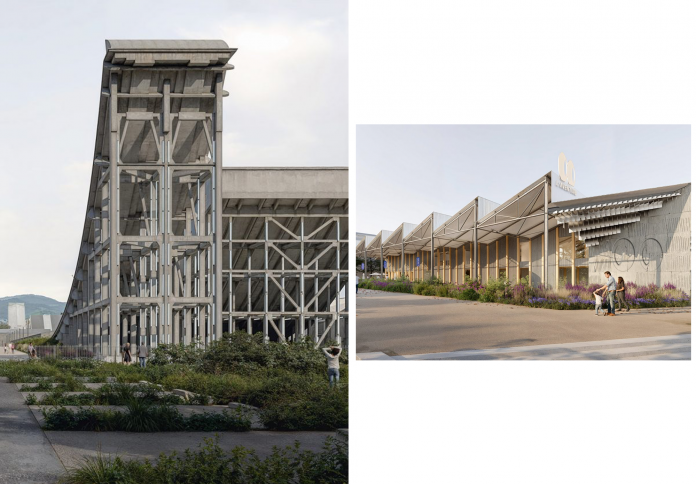
The architectural soul of the new Michelin Adventure lies in its rejection of the “big box” museum model. Kengo Kuma’s team approached the dormant factory not as a blank slate, but as a stable spatial framework. The existing building, characterized by its rhythmic sawtooth roof and vast 30-meter spans, will be meticulously stripped down, retaining only its original metallic frame. Into this steel cathedral, Kuma is introducing a sophisticated timber structural system. This new wooden skeleton follows the exact cadence of the original metal framework, creating a layered effect where the industrial heritage is simultaneously preserved and softened by natural materials.

This “building within a building” approach serves a functional as well as an aesthetic purpose. The timber inserts allow for the creation of intimate, human-scaled spaces within the cavernous hangar without compromising the openness that defined the factory floor. Engineering is the heart of Michelin, and Kuma’s design honors this through “bold technical expression.” By using timber for structural support rather than just decoration, the museum pays homage to the era of the “manufacture”—a term derived from the Latin manufactura, reminding us that even the most complex industrial innovations begin with the human hand.
The Imprint of the Industrial Past
On the exterior, Kuma’s intervention remains subtle yet transformative. The southern facade will be extended with dramatic metal canopies that echo the angularity of the original corrugated roof. These canopies shelter an external corridor that guides visitors toward the entrance, acting as a transitional space between the city and the curated world inside. Interestingly, the facade itself is a piece of art; it features vertical elements set between solid timber columns, spaced at precise intervals. Through a specialized process of “imprinting,” these elements reinterpret the profiles of corrugated metal, creating a visual rhythm that feels both modern and deeply rooted in the site’s manufacturing history.

The materiality of the project is a deliberate mix of high-tech and bio-based solutions. While the metal frame speaks to the 1960s, the new infill will utilize “hempcrete” (a mixture of hemp and lime) finished with a lime-concrete coating. This choice of materials reflects the industry’s shift toward sustainability, mirroring Michelin’s own evolution from rubber tires to broader environmental mobility. By choosing locally sourced, breathable materials, Kuma ensures the museum is not just a monument to the past, but a living example of how architecture can respond to the environmental challenges of the current decade.
A Lofty Sanctuary for the Brand’s Evolution
Inside the nearly 6,000-square-metre hall, the museum experience is organized around a central, circular enclosure. This “heart” of the museum will house the primary exhibition space, while the periphery of the building will host a curated selection of offices, a cafe, an events area, and a boutique. Movement through the museum is designed to follow the original proportions of the factory floor—visitors pass through narrow passages that suddenly open into expansive, light-filled halls. This play of compression and release is a signature of Kuma’s work, creating a sense of discovery as one navigates the brand’s history.

The interior palette is dominated by wood, stone, and the play of natural light. High overhead, the elongated windows of the sawtooth roof guide the sun across timber surfaces and concrete planes. At the building’s eastern end, a massive six-metre-tall sculpture of Bibendum—the iconic Michelin Man—stands as a guardian of the brand’s legacy. Bathed in daylight from full-height glazing, the figure serves as a focal point that bridges the gap between the corporate icon and the artistic centerpiece. The result is an interior that feels less like a traditional showroom and more like a “house of art,” where visitors are encouraged to linger and reflect.
Revitalizing the Quartier des Pistes
The Michelin Adventure museum is the centerpiece of a wider urban renewal project known as the Quartier des Pistes. For decades, this industrial district was a closed world of test tracks and manufacturing lines. Now, Kengo Kuma’s intervention is helping to stitch this area back into the fabric of Clermont-Ferrand. By creating a museum that is open, accessible, and surrounded by greenery-lined plots, the project is transforming an industrial “non-place” into a destination for the community. The site sits adjacent to large concrete test tracks, which will remain as silent witnesses to the speed and innovation that defined the 20th century.

This project represents the latest in a series of Kengo Kuma’s “topographical” works in France, joining the ranks of the Albert Kahn Museum in Paris and the Saint-Denis-Pleyel Station. In each case, Kuma’s philosophy remains the same: architecture should not be a “form” that is imposed upon a site, but a “landscape” that grows out of it. By preserving the industrial traces of the Michelin factory while infusing it with the warmth of timber and the clarity of Japanese design, the Michelin Adventure is set to become a landmark of industrial heritage. It reminds us that even as the world moves toward a digital future, the most meaningful stories are those etched in the materials of the physical world.