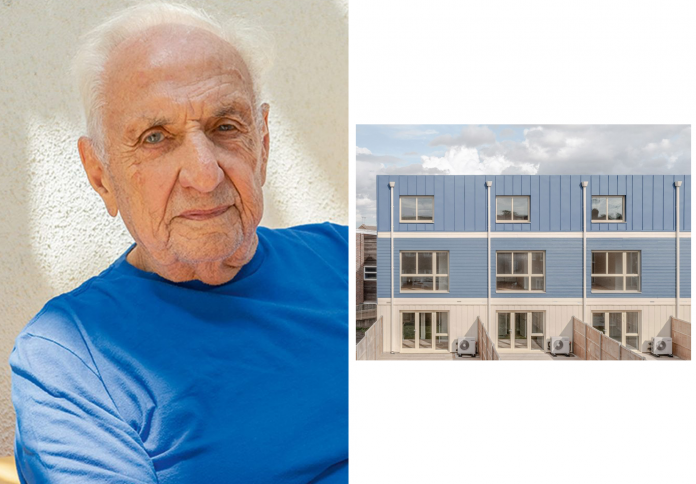
In the quiet village of Chalk, Kent, a new architectural presence has sparked a lively debate among residents and critics alike. Completed in late 2025 by London-based studio Office S&M, Goldsmith Mews is a four-home infill development that seeks to “punish” what the architects call the “generic suburbia” of the surrounding area. Draped in powder-blue fiber-cement weatherboarding and punctuated by nautical porthole windows, the project is a modern homage to the region’s lost timber cottages. While some hail it as a refreshing break from the beige, others in the “Dezeen Debate” have called it a “single misstep” in an otherwise stellar portfolio. As 2026 begins, Goldsmith Mews stands as a vibrant, if controversial, case study in how to introduce high-design personality into a traditional English village.
Challenging the Vernacular: Beyond Generic Suburbia
Goldsmith Mews was born from a desire to reclaim the architectural history of Chalk, a village famously frequented by Charles Dickens. According to Office S&M partner Hugh McEwen, the project aims to counter the “generic designs” that have dominated the area’s recent expansions. The studio looked back to the 1940s, when timber weatherboard homes were the local standard, and chose to reinterpret that tradition using contemporary materials and a bold, “dusty blue” and “buttery yellow” color palette.

The development replaces a row of derelict garages, turning a neglected infill site into a “contemporary mews” parallel to the street. The name itself is a tribute to the village’s past, honoring Sarah Goldsmith, the first landlady of the long-demolished Lord Nelson pub that once stood nearby. By weaving these historical threads into a strikingly modern form, the architects intended to create a building that feels “familiar, but like nothing you’ve ever seen before.”
Geometric Play: Piloti, Gables, and Portholes
The architecture of Goldsmith Mews is a collage of mid-century and maritime influences. McEwen cites Ernő Goldfinger’s Willow Road as a primary influence for the “undercut” ground floor, which uses piloti (structural pillars) to create sheltered parking and an inviting entryway. This move lifts the main living volumes, allowing the building to maintain a compact footprint while offering a sense of openness at the street level.
The upper levels are defined by a rhythmic series of neighborly gables and distinctive circular porthole windows. These elements, influenced by the industrial detailing of Jean Prouvé, lend the project its “coastal character.” While the street-facing side is clad in blue aluminum weatherboarding, the rear of the houses features “crinkle-crankle” walls—serpentine brickwork designed to “hug” the existing trees and provide a textured, organic boundary for the private gardens.
Internal Logic: The Multi-Generational Plan
Inside, the 1,180-square-foot homes follow a vertical logic designed for flexibility. The ground floor houses the main entrance and storage, while the first floor serves as the social heart of the home with an open-plan kitchen and dining area. Uniquely, the architects included a bedroom on this middle level, suggesting that it could serve as a home office or a separate annex for multi-generational living—a response to the shifting demographics of 2026.

The top floor contains two further bedrooms and bathrooms tucked under the slope of the roof, where dormer windows clad in zinc standing-seam provide views toward the Thames. Despite this traditional arrangement, the interior has been the subject of intense scrutiny. Some critics have pointed to the “abysmal space planning,” specifically noting a ground-floor WC that opens directly into the kitchen area—a design choice that fueled much of the heated “Dezeen Debate” in December 2025.
The Dezeen Debate: Surprises, Delights, and Detractors
The release of the project’s photography sparked a firestorm in the architecture community. In the December 2025 edition of the Dezeen Debate, readers were split between admiration for the “refreshing” color and disdain for the execution. One prominent commenter characterized the building as a “textbook example of self-created problems,” criticizing the tight parking clearances and the lack of a traditional “piano nobile” living space.
On the other hand, supporters praised Office S&M for their “joyful and precise” use of color in a country often dominated by “grey minimalism.” The debate underscores a wider tension in 2026 British architecture: the desire for “surprise and delight” versus the Vitruvian requirements of “commodity and firmness.” For Office S&M, being the subject of such a polarized discussion is a badge of honor, confirming that their “aim at generic suburbia” hit its mark.
A Sustainable Infill Model for 2026
Despite the aesthetic controversy, Goldsmith Mews is a notable success in terms of urban density. Office S&M obtained planning permission for four homes on a site where previous architects could only envision five, and they did so on a derelict plot that had been eyesore for years. The use of fiber-cement and aluminum ensures a low-maintenance, durable life for the building, while the “crinkle-crankle” walls preserve the site’s biodiversity.
As the village of Chalk continues to evolve, Goldsmith Mews serves as a permanent, powder-blue reminder that “heritage” is a living concept. It is a project that refuses to disappear into the background, choosing instead to start a conversation. Whether it is a “single misstep” or a “coastal masterpiece,” the mews has successfully carved out a colorful new identity for a historic corner of Kent.