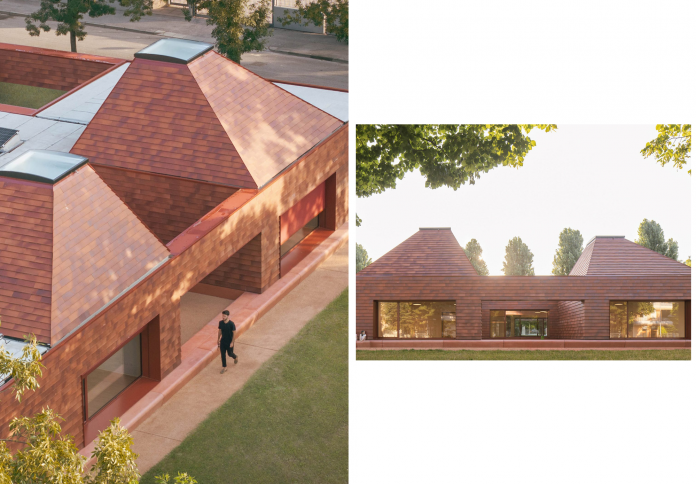
Rising from the fertile plains of Piove di Sacco in the Veneto region, Kinder Rain is a testament to the power of “recasting the rural archetype.” Completed in late 2025 by Milan-based studio AACM (Atelier Architettura Chinello Morandi), the kindergarten eschews the typical institutional look for a form that feels like a gathering of small, pyramidal homes. Drawing inspiration from the “Casone Veneto”—the traditional thatched-roof huts once inhabited by local farmers—the project translates historical memory into a contemporary ensemble of terracotta-clad volumes. As we enter 2026, Kinder Rain stands as a model for Italy’s “Scuola Futura” initiative, proving that sustainable, child-scaled architecture can provide a profound sense of belonging and “reddish unity” with the land.
The Small Village Concept: A Domestic Scale for Learning
The core philosophy behind Kinder Rain is the “small village” concept. Rather than housing all students in a single monolithic structure, AACM organized the school as an “abstract ensemble” of three autonomous classroom “houses.” This domestic scale helps pupils feel familiar with their own space while navigating the larger complex. Each house is defined by a steep, high ceiling that culminates in a skylight, designed to “ignite the imaginations” of the children below.

The layout is deliberately non-linear, organized around a central “agora” or communal plaza. This inner playroom acts as a shared center for collective activity and informal teaching, connecting the three classrooms functionally and visually. By removing traditional corridor systems, the architects created a spatial narrative of discovery, where diagonal views link the classrooms, the agora, and the gardens beyond.
A Skin of Terracotta: The Tectonics of “Reddish Unity”
Visually, the project is unified by its material palette—a continuous skin of terracotta tiles that wraps both the walls and the pyramidal roofs. This “mineral envelope” is a sophisticated revival of the region’s brick and tile building traditions. The choice of a single material creates a coherent figure that sits comfortably within its treed setting, responding dynamically to the shifting light and seasons of the Veneto landscape.

At the base of the building, a pigmented concrete bench runs along the perimeter, forming a “reddish unity” with the tiles. This bench is more than just a structural foundation; it thickens and expands into seating areas and an entrance plaza. It serves as a spatial threshold, a place for pause and interaction where children can experience the transition between the protective indoor environment and the sprawling 2,300-square-meter garden to the east.
Internal Geometry and Light: The Pyramidal Experience
The interior of Kinder Rain is a play of light and volume. The pyramidal roof geometry is fully expressed inside, creating varying ceiling heights that provide acoustic control and a sense of architectural rhythm. Wood fiber panels wrap the ceilings—a nod to the thatched roofs of the Casone Veneto—while providing the necessary sound absorption for a high-energy learning environment.

Natural light is a primary design element. In addition to the skylights, large south-facing windows and glass fronts ensure that the classrooms interact closely with the outdoors. Each classroom cluster is paired with a dedicated outdoor learning patio, a sheltered “external classroom” that allows students to experience wind, light, and seasonal changes as an active part of their daily curriculum.
Sustainability and the “Scuola Futura” Vision
Realized with the support of Italy’s National Recovery and Resilience Plan (PNRR) funds, Kinder Rain is a test bed for future public-school construction. The project emphasizes sustainability through passive environmental strategies, including the thermal mass of its terracotta skin, natural ventilation facilitated by the high ceilings, and the use of eco-conscious materials throughout. The building’s near-zero energy impact is a key requirement of the “Scuola Futura” framework.

The architects at AACM—Nicolò Chinello and Rodolfo Morandi—view the school as a “small educational landscape” rather than a mere building. By prioritizing social responsibility and pedagogical pertinence, they have created a space where architecture, color, and nature intertwine. In 2026, the project has already garnered significant attention, winning the “Young Architect Under 35” prize for its innovative approach to regionalism.
The Legacy of Kinder Rain in 2026
As the 2025/2026 school year progresses, the impact of Kinder Rain on the local community of Piove di Sacco is undeniable. The “abstract village” has become a landmark that honors the area’s rural history while offering a futuristic, high-quality learning environment. It is a place where boundaries between play and social interaction are intentionally blurred, encouraging children to navigate the building as an “unfolding landscape.”

Ultimately, Kinder Rain reminds us that the best educational spaces are the ones that feel familiar. By distilling the local casone into a precise, modern geometry, AACM has built a home for the imagination. In the plains of Veneto, the “little village” is open for business, and the children are busy writing its next chapter.