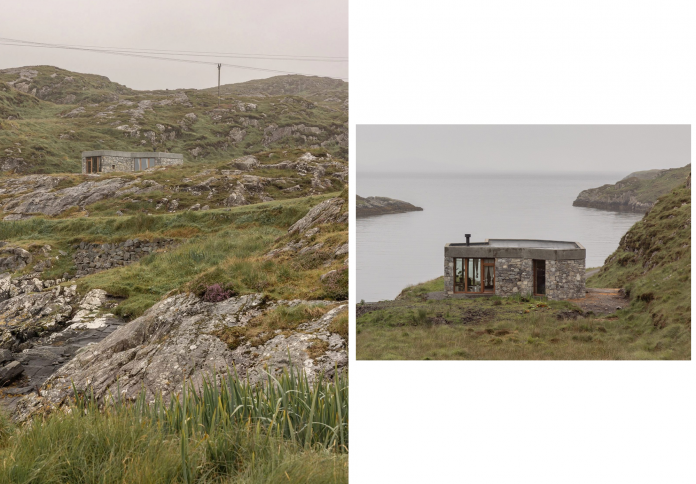
The Royal Institute of British Architects (RIBA) has crowned its 2025 champion, and the winner is a testament to the power of modest, site-specific design. Perched on a rugged sheltered inlet in the Bay of Harris, “Caochan na Creige”—Gaelic for “little quiet one by the rock”—is a stone-clad self-build that appears to grow directly out of the Outer Hebrides landscape. Designed by local practice Izat Arundell, the home was revealed as the winner during the final episode of Channel 4’s “Grand Designs: House of the Year” in December 2025. In a year where architecture has often leaned toward the monumental, Caochan na Creige stands as a defiant, beautiful reminder that the most profound structures are often the ones that listen most closely to the land.
A Unanimous Choice for the Hebrides
The decision to award Caochan na Creige the title of the UK’s best new home was, according to jury chair David Kohn, unanimous. The project faced stiff competition from a seven-strong shortlist, but it ultimately triumphed because of its “rare mixture of sensitivity and boldness.” Built on an incredibly challenging site in the Outer Hebrides, the house had to contend with a tight budget, an unforgiving climate, and the complex geological reality of building on ancient, hard rock.
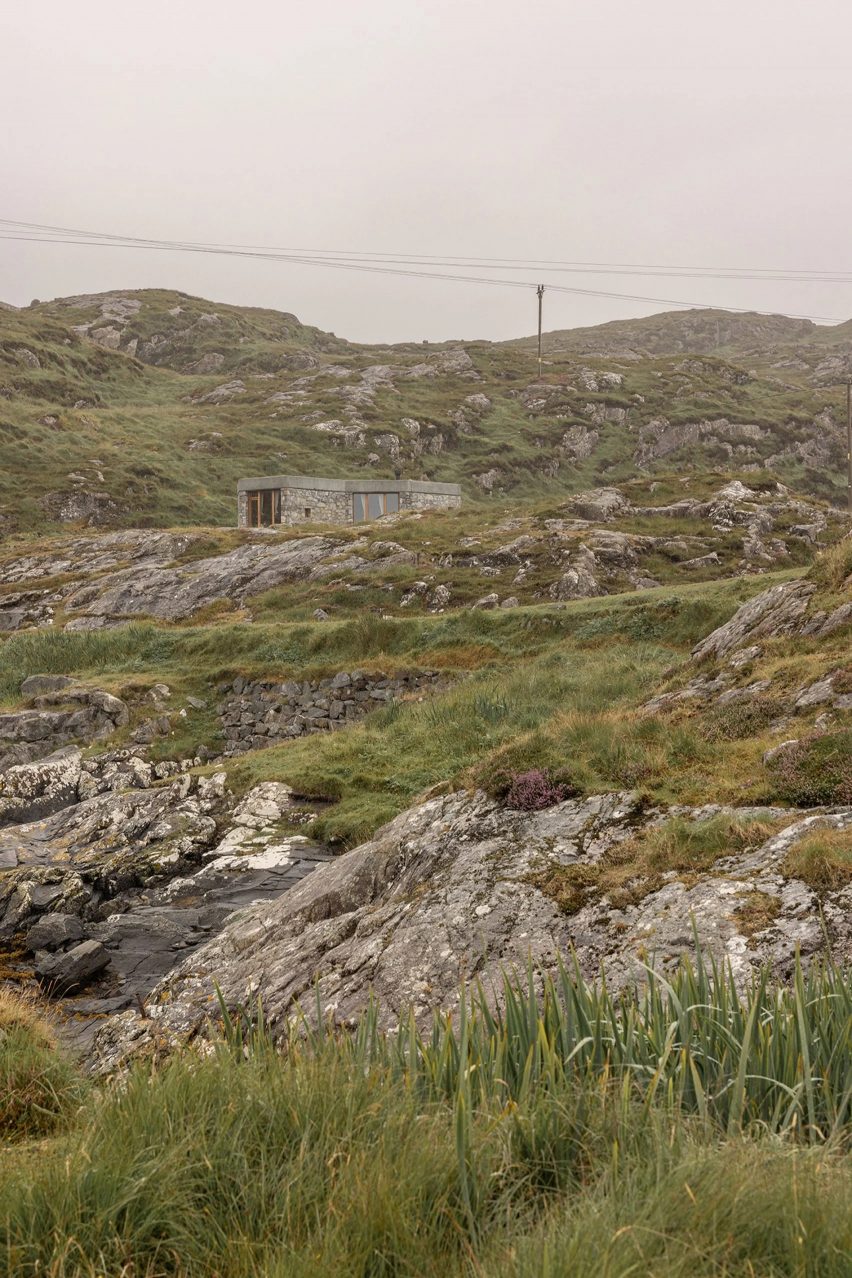
Architects Eilidh Izat and Jack Arundell, partners in both work and life, didn’t just design the home; they physically labored to build it. This “intensely personal” connection is felt in every detail of the 85-square-meter footprint. By utilizing an irregular, angled plan, the foundations were able to weave around the hardest sections of the rock, allowing the house to sit low and sheltered against the Atlantic gales.
The Materiality of the Rock: Local Stone and Timber
Materiality is the soul of Caochan na Creige. The exterior is clad in blocks of local Lewisian Gneiss stone, the same metamorphic rock that forms the bedrock of the island. This choice allows the building to visually dissolve into its surroundings, mirroring the textures and hues of the Harris coastline. An exposed concrete ring beam provides additional structural texture, acting as a contemporary “girdle” that grounds the timber-framed structure to the earth.
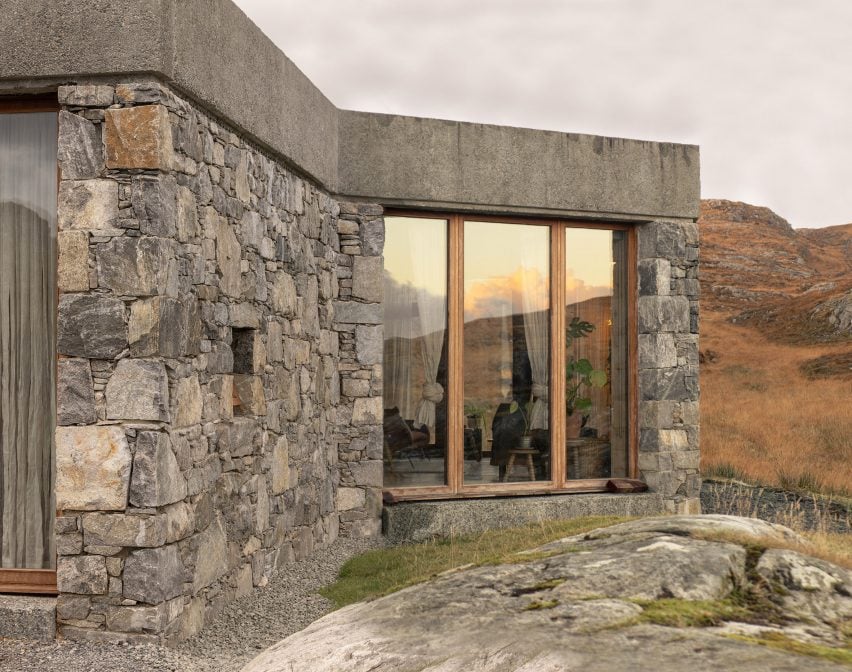
Inside, the home offers a warm, protective contrast to the rugged exterior. The rooms are lined with natural wood panelling, creating a cabin-like intimacy. Large, full-height windows are strategically placed to act as “living frames,” capturing specific views of the sea toward the Isle of Rùm. Despite its small scale, the interior feels expansive and light-filled, proving that “luxury” in 2026 is defined by a connection to nature rather than sheer square footage.
The Shortlist: A Diverse Architectural Landscape
While Caochan na Creige took the top prize, the 2025 RIBA shortlist showcased a broad spectrum of British domestic ingenuity. The six other finalists represented a mix of inventive extensions, sensitive barn restorations, and low-energy new builds:
- Hastings House by Hugh Strange Architects: A poetic extension “stitched” into a steep Hastings hillside, celebrated for its interplay of repair and invention.
- Triangle House by Artefact Studio: A playful, terracotta-tiled extension in Surrey that navigated a challenging triangular plot with sculptural precision.
- Amento by James Gorst Architects: A Suffolk home arranged around two “spinal” brick walls, lauded for its refined Scandinavian aesthetic.
- Jankes Barn by Lynch Architects: A masterfully restored timber-framed barn in Essex that retained its traditional silhouette while modernizing the interior.
- Housestead by Sanei + Hopkins Architects: A low-energy home in Suffolk noted for its environmental performance.
- London Brut by Pricegore: A curved brick home in North London that brought “joyful, precise” architecture to a quiet suburban corner.
A Blueprint for Sustainable Self-Builds
The victory of Caochan na Creige is a significant moment for the self-build movement in the UK. RIBA’s recognition of a project that prioritizes site-specificity and long-term resilience over stylistic trends sends a clear message to the industry. The home demonstrates how a modest budget and a small footprint can yield world-class results when shaped by “material availability and construction logic.”

Critics in early 2026 have praised the project for being “hopeful and imaginative,” qualities that align with the broader architectural shifts seen in the 2025 Stirling Prize (won by a social housing project). Caochan na Creige isn’t just a house; it’s a study in how to live well in remote contexts. It proves that by using the very materials that make a landscape difficult—the wind, the rain, and the rock—an architect can create a place of profound peace.
The Legacy of the “Little Quiet One”
As we move further into 2026, the influence of Caochan na Creige is already appearing in residential portfolios across the country. The “Hebridean self-build” has become a shorthand for vernacular resilience, encouraging a new generation of architects to look closer to home for their materials. The project’s success in last year’s Dezeen Awards (where it won Rural House of the Year) was merely a precursor to this ultimate domestic accolade.
In the end, Izat Arundell has built more than just a shelter; they have created a “sunny place” in an often dark climate. Whether it’s the meticulous stonework or the way the light hits the timber walls at dusk, Caochan na Creige remains a masterclass in architectural restraint. It is a home that doesn’t shout for attention, but in its quietness, it has become the most important house in Britain.