In the dense urban fabric of Da Nang, where narrow laneways often stifle light and air, a new residence has emerged that prioritizes the fundamental act of breathing. Completed in late 2024 and gaining international acclaim in late 2025, “Terracotta Breath” by Live Out Studio is a masterful exercise in multigenerational living. By utilizing a “porous” brick skin and a central, life-giving courtyard, the project transforms a modest 7×22-meter plot into a sanctuary of earthy warmth and filtered light. As we navigate 2026, the home stands as a quiet manifesto on how traditional materials like terracotta, bamboo, and timber can be repurposed to solve the modern challenges of urban density and tropical heat.
A Tale of Two Households: Multigenerational Harmony
The genius of Terracotta Breath lies in its ability to balance intimacy with independence. Designed for two distinct households—the parents and their daughter—the project is split into two separate residential units. The parents’ house occupies the front of the site, welcoming visitors with a sunlit garden that acts as a buffer from the street, while the daughter’s house is situated at the rear.

Connecting these two volumes is a shared open-air courtyard. This central void is the “lungs” of the project, facilitating cross-ventilation and allowing daylight to penetrate deep into both homes. For the family, this space is a communal theater of daily life, where moments of togetherness happen naturally across the threshold of the garden. In 2026, this model of “shared but separate” living is increasingly cited as a solution for Vietnam’s evolving family structures.
The Signature Skin: Perforated Brick and Passive Flow
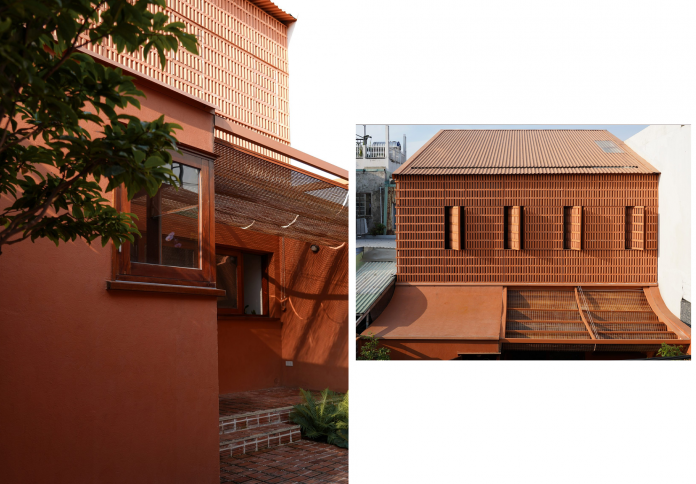
As its name suggests, the home is defined by its “breathable” exterior. Live Out Studio utilized perforated terracotta brick walls that function as a thermally responsive second skin. These walls incorporate angled bonding and operable panels, allowing the house to “inhale” the cool breezes of the laneway while filtering out the harsh glare of the tropical sun.

This “double-skin” strategy is particularly effective for the parents’ first-floor ceremonial hall. A small balcony is sandwiched between the outer brick layer and the inner sliding glass windows, creating a protected pocket of air that naturally cools the interior without the need for constant air conditioning. The resulting play of light—a dappled, shifting pattern of shadows—turns the simple masonry into a dynamic, living artwork that marks the passage of time throughout the day.
An Earthy Palette: Material and Cultural Grounding
The material language of Terracotta Breath is a “carpet of earth” that flows seamlessly from the facade to the garden paths. The palette is strictly local and sustainable: reddish-brown brick, bamboo, timber, and clay-colored render. Even the roof uses clay-hued corrugated sheets to maintain a cohesive, warm aesthetic that integrates naturally into the surrounding neighborhood.

Inside, the ground floor transitions from living to dining to kitchen with a minimalist restraint. The studio avoided unnecessary embellishment, focusing instead on texture. Terracotta wall tiles in the bathrooms and kitchens are paired with beige floor tiles and handwoven rope balustrades on the stairs. This tactile environment is deeply rooted in Vietnamese feng shui principles, ensuring that the energy within the home remains balanced and grounded.
Urban Strategy: Sophistication on a Budget
One of the most impressive aspects of the project is that it was delivered on a restrained budget. By focusing on local craftsmanship and humble materials, Live Out Studio proved that sophisticated architecture doesn’t require high-tech glass or expensive imports. The home feels larger than its modest footprint due to strategic window placement and the dissolving of boundaries between the interior and the courtyard.

In early 2026, Terracotta Breath has become a case study for compact urban design. It demonstrates that even in the most restricted laneways, architecture can provide a sense of expansive freedom. The house doesn’t just sit on the land; it feels as though it “grew from the ground itself,” offering a sustainable template for the future of Da Nang’s residential development.
The Legacy of Continuity and Breath
As the family settles into their second year in the home, the “continuity of care” that the design promotes is evident. The sculpted staircase leads to a prayer room that doubles as a community gathering hall, honoring tradition while the younger generation finds their own space at the rear. The architecture allows for silence, shadows, and the soft brushing of greenery against textured walls—the “quiet delights” that define a home.
Ultimately, Terracotta Breath is more than a shelter; it is a testament to the power of mindful living. In the bustling heart of a Vietnamese city, Live Out Studio has built a place where air, light, and family bonds are the primary building blocks. The era of the sealed glass box is fading, replaced by a “living, breathing architecture” that knows exactly how to weather the storm and catch the breeze.