In the heart of Houston, the Rice University School of Architecture has undergone a transformative “programmatic re-invention.” Completed in late 2024, Chicago-based studio Kwong Von Glinow’s renovation of MD Anderson Hall is a surgical intervention that balances the heavy weight of history with the fluid needs of a modern design hub. By digging into the layers of the building’s past—from its 1947 Neoclassical roots to James Stirling’s iconic 1981 Postmodern addition—the architects have “found” space within the existing footprint. As 2026 begins, the project serves as the connective tissue for the school’s new “campus within a campus,” proving that the most sustainable way to build the future is to meticulously unearth the stories already written in the walls.
The Architectural Palimpsest: Staub, Stirling, and Beyond
The renovation of MD Anderson Hall was not a simple aesthetic refresh; it was a deep dive into an architectural palimpsest. The building was originally designed in 1947 by Staub and Rather in a restrained brick Neoclassical style. In 1981, it was famously expanded by Pritzker Prize-winner James Stirling and Michael Wilford, marking Stirling’s first project in the United States. Kwong Von Glinow, founded by Lap Chi Kwong and Alison Von Glinow, began their process by researching these two distinct eras to find “moments of intersection” where a third layer could be added.

The resulting 3,775-square-foot (350-square-metre) renovation focuses on three strategic nodes: a Welcome Center, a Student and Community Forum, and a Faculty and Staff Lounge. By placing these programs along the building’s central axis, the architects have improved the school’s internal circulation while creating a “front door” that invites the wider Rice community to engage with architectural discourse.
The Welcome Center: Transparency and Reflection
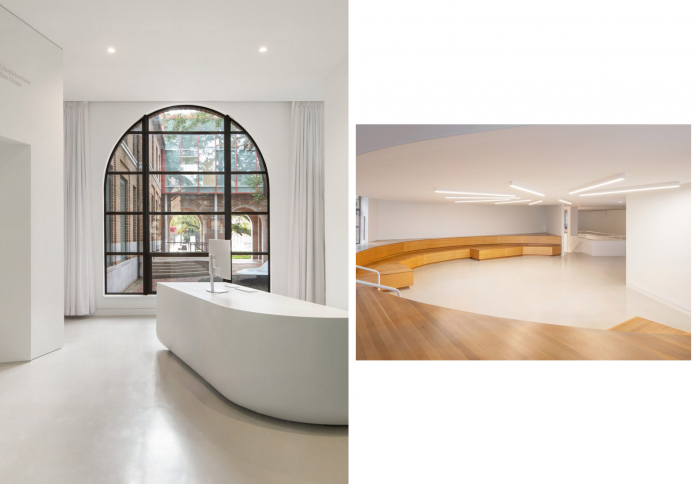
Located at the southeast corner, the new Welcome Center serves as the primary entry point for guests and prospective students. The most dramatic move was the replacement of an opaque brick wall with two expansive glass panels, creating a visual “porosity” between the academic quad and the school’s inner workings. This transparency reflects the school’s forward-looking mission under Dean Igor Marjanović to foster open dialogue and community engagement.

Inside, a mirror-clad structural column serves as a direct homage to Stirling and Wilford’s signature west facade. By reflecting the surrounding quad and the building’s brickwork, the column “camouflages” its structural necessity while introducing a layer of playful visual complexity. This is balanced by a monolithic welcome desk and curvilinear glass walls that define staff offices, encouraging visitors to step further into the building’s gallery spaces.
The Community Forum: A Social Node
Directly above the Welcome Center is the Student and Community Forum, a multi-tiered gathering space designed for informal interaction. This area is critical to the school’s new layout, as it provides an accessible walking ramp and stairs that bridge the height difference between the historic MD Anderson Hall and the newly constructed William T. Cannady Hall by Karamuk Kuo.

The centerpiece of the forum is a two-tiered, circular built-in seating system. These “curving tiers” create a natural amphitheater for student discussions, pin-ups, or simply a place to pause between classes. The design uses warm wood grains and gallery-white surfaces to maintain a neutral backdrop for architectural production. By integrating the ramp into the seating geometry, the architects have made accessibility an expressive part of the room’s social architecture.
The Faculty Lounge: Delineating Private and Public
The final component of the renovation is the Faculty and Staff Lounge, which reconfigures the former reception area. To manage the balance between private work and social amenity, Kwong Von Glinow inserted a three-sided “wedge-like” volume. This geometric intervention creates a clear delineation between the public reception and the more private faculty zones, which include a kitchenette, a lounge area, and updated ADA bathrooms.

This “wedge” allows natural light to penetrate deep into the interior while providing a sense of enclosure. The use of minimalist materials and sharp geometries aligns with the firm’s philosophy of building “the thoroughly enjoyable from the slightly familiar.” In 2026, this lounge has become a vital hub for faculty research and cross-disciplinary debate, supporting the school’s mission to advance “planetary engagement.”
The Legacy of 2026: A Campus Within a Campus
As we settle into 2026, the MD Anderson Hall renovation stands as a masterclass in “Design through Finding.” By choosing to reveal and enhance the building’s rich history rather than overwrite it, Kwong Von Glinow has ensured that the Rice School of Architecture remains a living archive of pedagogical shifts. The project, which recently won an AIA Chicago Honor Award, proves that small-scale interior interventions can have a monumental impact on a university’s culture.

Combined with the high-tech fabrication halls of the adjacent Cannady Hall, the renovated MD Anderson Hall completes a sustainable, cohesive “campus within a campus.” It is a place where the brick traditions of the past meet the glass-and-mirror transparency of the future—a building that is as much about the “rich history” it preserves as the new generation of architects it inspires.