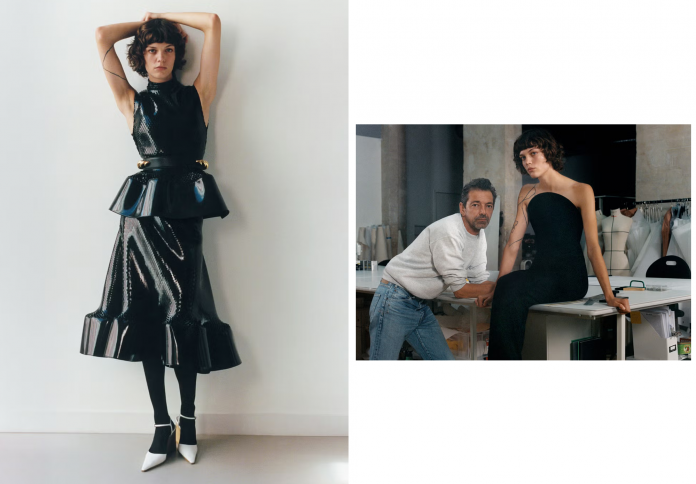
As the current creative director of Alaïa, Pieter Mulier has successfully steered the legendary Parisian house into a new era by fiercely guarding the late founder’s commitment to craft, intimacy, and the unyielding pursuit of pure desire. Since his 2021 appointment, Mulier has cut through the clamor of the modern fashion cycle, proving that success does not require influencer marketing or rapid product turnover. Instead, he has focused on designing clothes that awaken the desire to dress and invite the wearer to take up space, resulting in pieces that are neither tricky nor trendy. His philosophy—that “creativity is the new luxury”—has resonated deeply with a new generation of sophisticated consumers, transforming the house into a magnet for women, from Zendaya to Rihanna, who seek clothes that command attention without having to shout.
Preserving Intimacy in a World of Scale
Pieter Mulier’s approach to leading Alaïa is fundamentally rooted in preserving the singular, intimate philosophy established by the founder, Azzedine Alaïa, while gently evolving the brand for the 21st century.

Mulier, who previously worked alongside the fast-paced, high-volume operations of Raf Simons at Jil Sander and Dior, consciously chose a different path at Alaïa. His main objective is to be the “keeper of the house,” prioritizing fierce devotion to craft and taking the time necessary for ideas to breathe. He maintains a tightly knit inner circle, notably refusing to work with stylists or merchandisers, and intentionally produces fewer collections than the industry standard. This deliberate slowness counters the pressure of the “attention economy,” embodying his belief that time is integral to the brand’s identity and that true classics, like the mesh ballet flat, must be given time to settle into the market organically.
This focus on intimacy even extends to his own working methods. Mulier often visits the flagship store to observe women interacting with the collections, occasionally offering honest styling advice—a practice almost unheard of for a major fashion house’s creative director. This direct connection with the client base allows him to ensure that the clothes, which are designed to be singular, small, and deeply considered, truly resonate with the women who wear them.
The Return of Sculptural and Architectural Form
Under Mulier’s stewardship, Alaïa has found new relevance by designing pieces that are a dissertation on shape, moving beyond the brand’s famous “King of Cling” silhouettes.

His collections are characterized by architectural exploration and conceptual abstraction of the body. Recent runway shows, such as the Winter Spring collection at the Guggenheim Museum, featured groundbreaking, gravity-defying silhouettes: billowy dresses suspended by curved boning, balloon pants that instantly spawned contemporary knockoffs, and flouncy minis reminiscent of classic American couture. These creations—including dresses that wind around the body and snap into place—emphasize shape and volume, challenging the wearer to adopt an empowered, space-taking stance.
Critically, Mulier has moved away from the founder’s focus on head-to-toe looks, instead designing separate pieces that invite the client to integrate them into her existing wardrobe. This shift is practical yet still creatively demanding. By focusing on exaggerated forms—such as barrel-leg jeans or sheer pants with undulating peplum hips—Mulier’s pieces stand alone, ensuring they remain the commanding centerpiece of any outfit.
Creativity as the New Luxury Metric
Mulier is a staunch antagonist of trends and the hyper-speed consumption encouraged by the digital sphere, asserting that uniqueness and genuine creativity are the ultimate markers of contemporary luxury.

His adamant stance is simple: “If you see it on Instagram, I cancel it the day after.” Mulier is fiercely committed to creating fashion that is fundamentally “different,” believing that if a concept becomes part of the circulating noise of newsletters and online trends, it immediately loses its value for Alaïa. He operates under the belief that the brand’s unique codes should draw people in based on the merit of the output, rather than through paid visibility or forced hype.
This strategy positions the brand as a beacon for customers “starved for ways to express themselves” authentically. As described by buyers, Alaïa’s clothing “doesn’t shout, but it commands attention,” offering an intelligent, quiet sensuality. In an industry increasingly focused on quick returns and bankable accessories, Mulier ensures that the pursuit of pure desire and artistic creativity is put before the mere transaction of selling merchandise.
Bridging the Dream with the Ready-to-Wear Reality
Mulier has successfully translated the high-art fantasy of the runway—the essence of haute couture—into ready-to-wear pieces that are both conceptual and commercially viable for the modern client.

Where Azzedine Alaïa’s house often felt like a “private club,” Mulier has broadened the brand’s accessibility. He insists that his runway shows “should still make you dream,” citing his Summer Fall collection, which abstracted the body with sheer hooded bodysuits and cylindrical tubes. Yet, he simultaneously ensures that the fantasy is grounded in reality. The pieces, when “dissected,” are easy to buy and style. Rihanna’s celebrated custom tube-hipped skirt, for instance, was noted for its ability to be worn simply with a T-shirt while still remaining “sublime.”
This ability to produce evocative shows while creating wearable pieces has attracted a powerful new roster of devotees, including Zendaya, Miley Cyrus, and Taylor Russell. This organic, unpaid endorsement from fashion movers ensures that the Alaïa legacy is alive and evolving, making the brand a desirable starting point for Gen Z fashion enthusiasts whom Mulier hopes will collect and cherish his designs forever.