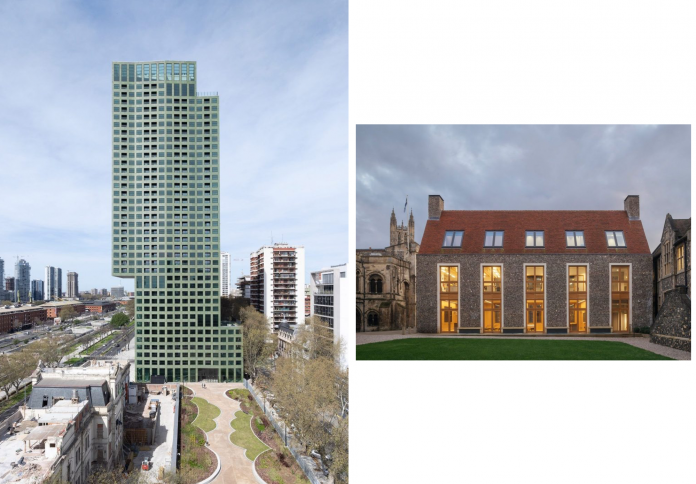
The opening of the Rausing Science Centre at The King’s School in Canterbury, designed by Walters & Cohen Architects, has provoked a lively and often polarized discussion among Dezeen readers, serving as a case study for the contemporary debate surrounding heritage, context, and modern architectural expression. The project, which replaced an existing science block, features striking façades of knapped flint and timber, aiming to blend the functionality of a state-of-the-art laboratory with a sympathetic material palette drawn from the historical context of its surroundings. The comments section revealed a sharp divide between those who lauded its material honesty and contextual sensitivity and those who criticized its scale and perceived stylistic compromise in relation to the school’s ancient campus.
The Debate Over Context and Materiality
A significant portion of the online commentary focused on the architects’ choice of materials, specifically the use of knapped flint and brick, which directly references the historic buildings of Canterbury.

Many readers praised Walters & Cohen for their thoughtful contextual approach. The use of knapped flint—a traditional material found throughout the ancient city and the school’s existing structures—was seen as a sophisticated attempt to ground the modern building in its heritage. Commenters appreciated the finely articulated detailing and the high quality of the craftsmanship, noting that the texture of the flint gave the façade a depth and warmth rarely seen in contemporary school architecture. For these critics, the design represented a successful example of architectural diplomacy, allowing a bold, modern structure to exist respectfully within a historically sensitive setting.
Critiques of Scale and Form
Conversely, a strong contingent of critics took issue with the building’s overall massing and its ability to truly integrate with the venerable, often imposing, character of the existing school campus.

Some readers felt that despite the nod to local materials, the scale and cubic form of the new science centre were too dominant and felt aesthetically dissonant next to the older, more intricate gothic structures. The building was labeled by some as overly cautious or stylistically safe, failing to achieve the kind of bold, challenging modernism that truly pushes boundaries, while also not fully disappearing into the background. The core tension articulated in the comments was whether the design was a genius compromise or a missed opportunity—a building that tried too hard to please both the modernist and the preservationist camps and ultimately succeeded fully in neither.
Functionality Versus Aesthetics in Educational Design
Beyond the aesthetic debate, readers engaged in a discussion about the practical success of the building, focusing on whether the high-design concept successfully delivered a state-of-the-art educational environment.

Those defending the project highlighted the clarity of the internal planning, which features light-filled laboratories and flexible teaching spaces designed to foster collaborative learning. The large windows and internal transparency were seen as vital for creating an inviting, modern learning atmosphere essential for attracting students to science subjects. However, even on the topic of function, some critics questioned the long-term practicality of such a highly finished building in a busy school environment, suggesting that the aesthetic demands might eventually conflict with the rough-and-tumble reality of daily student use and maintenance costs.
The Broader Debate: Modernism in Historic Contexts
The commentary surrounding the Rausing Science Centre inevitably broadened into the perennial architectural debate: how should contemporary buildings respond to highly protected historic environments?
The building serves as a perfect example of the current architectural zeitgeist, which often favors contextual sensitivity and material dialogue over overtly contrasting, brutalist modernism. The discussion ultimately became a proxy war between architectural philosophies. One side argued for the integrity of the new, believing a new structure should be distinctly of its time. The other side championed a respectful dialogue, arguing that a historical context demands a subtle approach where new architecture should be subservient to the existing heritage. The Rausing Centre, therefore, remains a complex and celebrated project that perfectly captures the difficulties and rewards of building in a place like Canterbury.