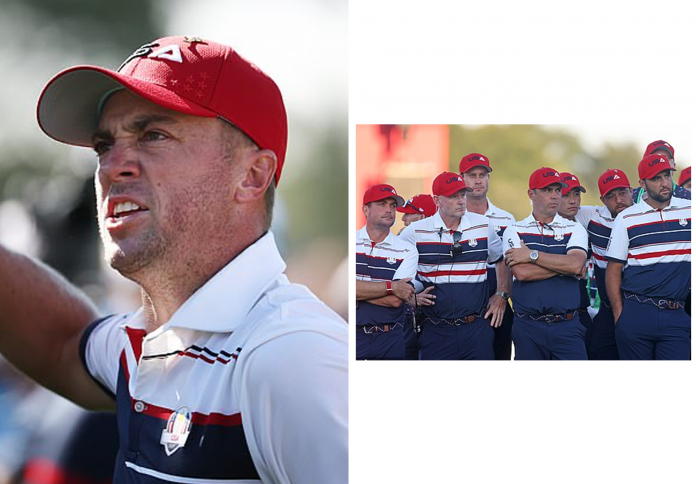
The dust has barely settled on the 2025 Ryder Cup at Bethpage Black, yet the post-mortem of the American defeat has already begun with a startling level of transparency. In a revealing December interview with the “No Laying Up” podcast, later detailed by the Daily Mail, Justin Thomas broke the silence on the internal discord that plagued Team USA during their disappointing home performance. While the public saw a united front led by captain Keegan Bradley, Thomas’s account paints a picture of a team fighting not just the Europeans, but the very infrastructure designed to support them. From heated arguments with grounds crews to the “bizarre” disconnect between the captain’s vision and the reality of the course setup, Thomas’s reflections suggest that the American shield was cracked long before the final putt dropped on Sunday.
The Green Speed Civil War
The most striking revelation from Thomas’s post-Cup analysis involves a literal “war of words” on the greens of Bethpage. Thomas detailed a series of heated exchanges between the US players and the local grounds crew regarding the speed of the putting surfaces. According to Thomas, Captain Keegan Bradley had specified a particular “Stimpmeter” reading to favor the American style of play, yet the reality on the course was drastically different. “I watched them argue with us that they were 13s [on the Stimpmeter],” Thomas recalled with visible frustration. “It’s like, ‘Guys, we play golf every week… look on TV at how many guys are leaving putts short.'”
This internal friction created a “bizarre” atmosphere where the home-field advantage was effectively neutralized. Thomas noted that the primary benefit of hosting a Ryder Cup is the ability to dictate course conditions, but at Bethpage, that line of communication appeared to have broken down completely. The sight of world-class players arguing with staff mid-tournament over green speeds served as a microcosm of the lack of synergy that defined the American week, leaving the squad feeling like they were fighting a battle on two fronts.
The Weight of the Bradley Captaincy
Central to the 2025 narrative was Keegan Bradley’s unconventional path from “snubbed player” in 2023 to “unexpected captain” in 2025. While Thomas had previously lauded Bradley’s commitment—even admitting that Bradley “deserved” his 2023 spot more than he did—the pressure of the captaincy in New York proved to be a different beast. Bradley’s decision to remain a non-playing captain, despite his surging form throughout the summer of 2025, became a lightning rod for criticism as the Americans fell into a deep seven-point hole by Saturday night.
Thomas admitted that the team felt “gutted” for Bradley, who had pinned his entire professional redemption on a Bethpage victory. However, the emotional weight of Bradley’s journey may have inadvertently contributed to the “trying too hard” syndrome that European veterans like Justin Rose observed from across the aisle. The intensity Bradley brought to the role—famously shouting “Let’s f***ing go, boys!” at 5:45 AM—seemed to clash with the technical and logistical failures occurring behind the scenes, creating a disconnect between the team’s spirit and its execution.
A “Disaster” of Pairings and Preparation
The technical failings extended to the tactical decisions made in the team room. The 2025 Ryder Cup was marred by what many analysts called a “pairings disaster” on Friday morning, where the US side looked completely out of sync. Thomas himself was at the center of this, struggling to find a rhythmic partnership despite his status as one of the few experienced veterans on a relatively young squad. The irony of the situation was not lost on critics: Bradley, who had been a victim of pairing decisions in the past, found himself “flunking” his first major test as the man in charge.
Thomas reflected on the preparation, noting that the team perhaps relied too heavily on previous successes rather than adapting to the specific challenges of Bethpage. The absence of a “natural and organic” bond—as highlighted by the European side—led to a performance that felt forced. Despite the players being “best mates” off the course, that friendship failed to translate into points when the pressure of the New York crowd and the relentless European scoring hit its peak.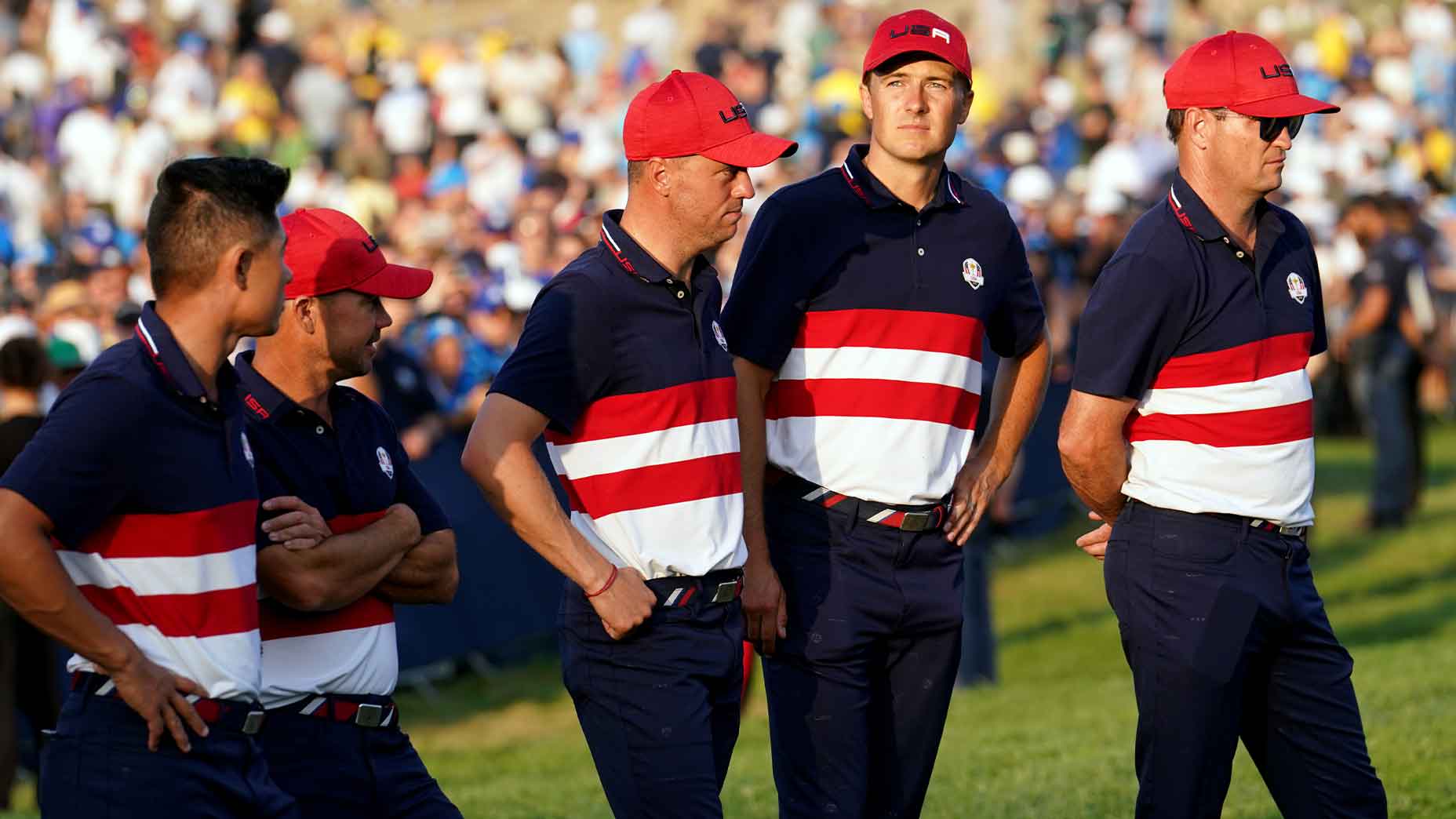
The Road to 2027: Learning from the Wreckage
As the USGA and the PGA of America look toward the 2027 Ryder Cup at Adare Manor, Thomas’s candid remarks serve as a vital warning. The internal infighting and the “bizarre” logistical errors of 2025 cannot be repeated if the Americans hope to end their losing streak on foreign soil. For Thomas, the lesson is one of humility and adaptability. “We have to roll with the punches,” he noted, acknowledging that the American team must find a way to align its leadership, its players, and its home-course support into a singular, cohesive unit.
The 2025 cycle has ended with a sense of “what could have been.” For Keegan Bradley, the suitcase he vowed never to unpack remains closed, its contents a reminder of a mission unfulfilled. For Justin Thomas, the focus shifts back to his individual game as he prepares for a 2026 season that he hopes will be defined more by major trophies and less by mid-tournament arguments. The “Judgment Day” at Bethpage Black may be over, but the echoes of its internal friction will likely resonate through the American camp for years to come.