As 2025 draws to a close, the global restaurant scene has revealed a dramatic shift in architectural priorities, moving away from the clinical minimalism of previous decades toward a more tactile, material-led future. This year’s standouts—ranging from “urban greenhouses” in Mexico City to cinematic diners in Shanghai—share a common thread: an unapologetic embrace of texture and color. Designers have looked beyond standard surfaces to experiment with volcanic ceramic, mycelium, and repurposed aluminum, creating environments that are as much a feast for the eyes as the menu is for the palate. In a world increasingly dominated by digital interactions, these ten projects remind us that the physical act of dining is most powerful when set within a space that demands an emotional and sensory response.
Cinematic Grandeur and Saturated Palettes
The most talked-about interior of the year arrived in Shanghai, where legendary film director Wong Kar Wai collaborated with local designers to create Mi Shang. Drawing on his signature cinematic style, the restaurant is a masterclass in mood, utilizing a highly saturated, “color-drenched” palette that makes every diner feel as though they have stepped onto a 1960s film set. The use of warm, adaptive lighting and reflective surfaces creates a dreamy, timeless atmosphere that challenges the typical “bright and airy” restaurant trend. It is a space designed for lingering, where the architecture itself tells a story of urban romance and nostalgia.

Similarly bold in its execution is Challe in Kyoto, designed by UNC Studio. This Japanese-Mexican fusion eatery occupies a traditional wooden house, but any sense of “orthodox” tradition is shattered by an all-red interior. By drenching every surface—from the original timber beams to the modern seating—in a single, vibrant hue, the designers have fused the cultural energies of Mexico and Japan into a singular, high-octane environment. It is a daring move that highlights how contemporary designers are using color not just as an accent, but as a primary structural element that defines the entire dining experience.
Material Innovation: From Mycelium to Volcanic Ash
One of the defining trends of 2025 has been the use of experimental, bio-based materials to create “organic” interiors. In several of the year’s top-ten projects, designers moved away from traditional plastics and foams in favor of mycelium—the root structure of mushrooms. These restaurants feature rounded, fungal forms and soft, earthy textures that “grow” within the existing architectural shell. This isn’t just a sustainability statement; it is a new aesthetic language that prioritizes soft edges and biological shapes, creating a “calming cocoon” that feels fundamentally different from the rigid geometry of the modern city.

In London, North End Design utilized more industrial but equally tactile materials for Town, a restaurant in Covent Garden. The space is anchored by volcanic ceramic pillars and chrome accents, drawing inspiration from 1980s Japanese boardrooms and 1960s British car design. The inclusion of these rugged, mineral-based textures provides a “grounded” feel to a space that is otherwise playfully futuristic. This focus on “touchable” architecture—where the surface of a pillar or the weight of a table adds to the narrative of the meal—is a hallmark of the most successful projects this year, proving that materiality is the new frontier of luxury.
The Urban Greenhouse and the Modern Oasis
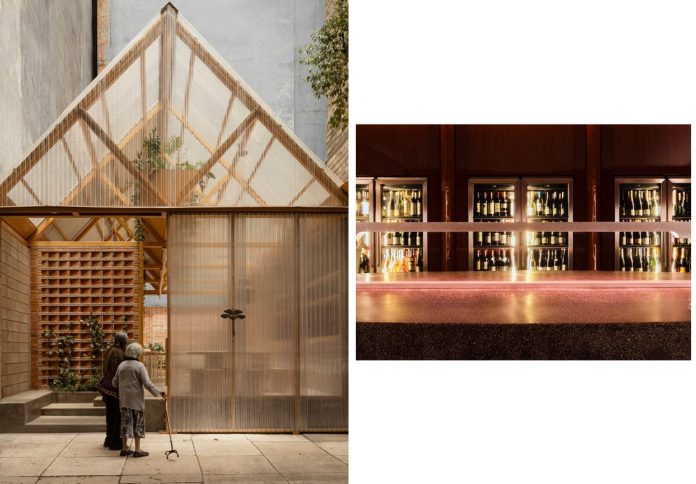
The concept of the “urban greenhouse” found its peak expression this year in Mexico City with Plumbago, designed by OPA. Composed of two gabled volumes, one of which is clad in corrugated polycarbonate sheeting, the restaurant functions as a translucent pavilion in the heart of the Cuauhtémoc neighborhood. By day, the space is flooded with soft, diffused light, blurring the boundaries between the interior and the street. By night, the building glows like a paper lantern, serving as a beacon of community and warmth. It is a lightweight, airy approach to dining that emphasizes transparency and a connection to the city’s climate.

On the other side of the Atlantic, AE02’s Millo in Bucharest offers a more “theatrical” version of the urban oasis. Utilizing high-gloss materials, lacquered walnut walls, and reflective microcement flooring, the restaurant creates a high-contrast environment that feels both sophisticated and energetic. Geometric cut-outs in the walls provide curated glimpses into the kitchen, turning the culinary preparation into a visual performance. Whether through the lightness of a greenhouse or the drama of a theater, these spaces succeed by creating a “world within a world,” offering an escape from the urban grind through thoughtful spatial planning.
Retro Revivals and Historical Reinventions
Finally, 2025 saw a sophisticated return to “classic” dining forms, albeit with a modern twist. In East London, local studio House of Dré designed Tom’s Pasta to evoke the familiar, playful feel of a classic Italian trattoria, using Formica, leatherette, and dark-wood furniture. Meanwhile, the restaurant group Lina Stores expanded its footprint by transforming a Grade II-listed former bank into a pastel-hued outpost, meticulously preserving original architectural features while inserting their signature mint-green identity. This trend of “respectful reinvention” shows that the most forward-thinking designers are often those who know how to listen to the history of a building.

From the oxblood tones of Mimi in Edmonton to the undulating “wave” ceilings of Ánimo in New York, the top restaurants of 2025 have proven that there is no single “right” way to design a dining space. Instead, the year has celebrated diversity, audacity, and a renewed commitment to the craft of interiors. These ten projects represent the pinnacle of the hospitality industry’s creative output, offering a glimpse into a future where every meal is an immersive journey into color, light, and material. As we look toward 2026, the bar for restaurant design has been set remarkably high, with a focus on spaces that are as memorable as they are functional.