In the quiet residential tapestry of Finsbury Park, North London, a modest architectural intervention is proving that “monumentality” is not a matter of square footage, but of civic soul. The Stroud Green Housing Centre, designed by the local studio Owain Williams Architects, occupies a site that was once a derelict concrete garage—a magnet for antisocial behavior and neglect. In its place now stands a 38-square-metre timber-clad pavilion that serves as the permanent headquarters for the Stroud Green Housing Co-operative. By utilizing height, light, and a sequence of “exaggerated rituals,” the architects have created a public building in miniature. It is a space that offers dignity to the residents who visit for support, proving that even the most constrained urban plots can be transformed into beacons of hope and community resourcefulness.
Transforming the Residual into the Essential
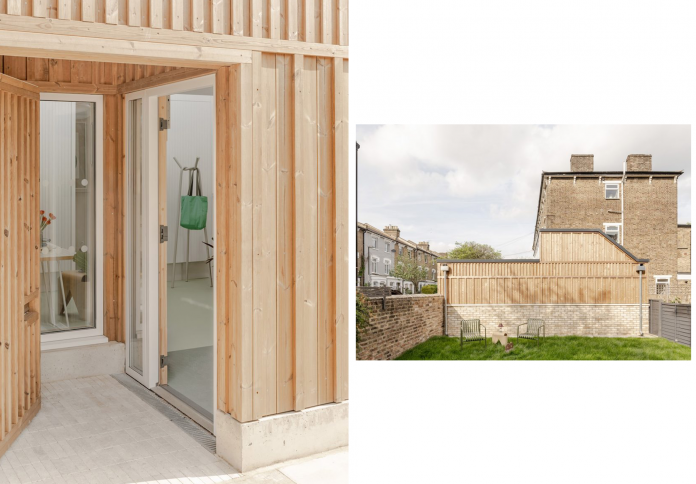
The journey of the Stroud Green Housing Centre began with a search for meaning within the “residual” land of a housing estate. Owain Williams Architects were tasked with replacing the co-operative’s cramped, outdated corner office with a dedicated facility that could handle day-to-day operations and host annual general meetings. The choice of a disused garage site provided the perfect opportunity for urban renewal. Clad in pinkish-brown Scots Larch, the building’s façade features a rhythmic arrangement of flat and projecting battens that mimic the surrounding garden fences, allowing the structure to nestle comfortably into its suburban context while maintaining a distinct architectural identity.

Despite its tiny footprint, the building’s presence is anchored by a concrete plinth and timber panels arranged to evoke classical columns—a subtle nod to the language of grand civic institutions. This “miniature monumentality” is central to the project’s mission: to give the co-operative and its tenants a sense of confidence and permanence. By taking a site of decay and turning it into a polished, high-functioning office, the architects have demonstrated how small-scale architecture can act as a catalyst for local pride, reclaiming a neglected corner of the neighborhood for the common good.
The Ritual of the Oversized Gate
Perhaps the most defining gesture of the project is the sequence of arrival. Visitors are received by a disproportionately large timber gate that serves as the building’s “civic face.” Each morning, the gate is unlocked and fixed open, transforming the building from a defensible, closed box into an open, welcoming porch. This porch features a mirrored ceiling that visually extends the public realm into the site, creating a moment of reflection and transition before one even enters the office. This daily ritual of “waking the building up” reinforces its role as a public servant, making the act of entering the space feel deliberate and dignified.

The transition from the street to the interior is designed with a level threshold, a non-negotiable requirement for a building intended for “everybody.” This seamless entry point underscores the co-operative’s values of inclusivity and accessibility. Once inside, the mirrored porch gives way to a small waiting area, where the journey from the public pavement to the intimate workspace is completed with a sense of ceremony. This attention to the “ritual of entry” elevates the building beyond a mere office, framing it as a vital threshold where residents can seek the support and advice they need in a calm, human-centered environment.
A Symphony of Color and Volume
To maximize the perception of space within the 38-square-metre interior, the architects utilized a tall, central clerestory roofline. This architectural “lift” draws in diffused northern light, illuminating the plan without the risk of overglazing, which could compromise the privacy of those inside. The ceiling drops gently toward the rear of the building, creating more intimate zones for the kitchenette and archival storage. The use of north-facing windows also enables passive ventilation, allowing the building to breathe and cool itself naturally—a sustainable strategy that aligns with the co-operative’s resourceful ethos.

The interior is cleverly zoned through the use of color rather than physical partitions. Teal vinyl flooring defines the entrance and waiting area, transitioning into a soft mint green for the permanent desk space. At the rear, a vibrant yellow kitchenette provides a warm, domestic heart to the office. This color-coding, paired with half-height wall panelling and slatted, floor-to-ceiling storage, brings a sense of refined order to the compact plan. Every inch of the building works “double-duty,” from the joinery that hides archives to the plinth that provides a shelf for displaying community announcements, ensuring the space feels generous rather than cluttered.
The Quiet Power of Listening First
Ultimately, the Stroud Green Housing Centre is a testament to what can be achieved when architecture “listens first.” The design was developed through intensive consultation with the co-operative’s staff and members, ensuring that the finished building reflects their daily needs and organizational values. It is a project that avoids the “showy” or the “exuberant,” opting instead for a quiet, self-conscious earnestness. By prioritizing accessibility, light, and materiality over grand gestures, Owain Williams Architects has created a space that feels deeply human—a place where the smallest details contribute to a larger sense of community well-being.

As the co-operative settles into its new home, the Housing Centre stands as a model for “micro-civic” architecture. It proves that the quality of a public space is not measured by its scale, but by the dignity it affords its users. In a city where large-scale development often overlooks the granular needs of local neighborhoods, this timber-clad office provides a refreshing alternative. It is a building that puts the “gentle work” of community support at the forefront, proving that sometimes, the most monumental gestures are indeed the quietest ones.