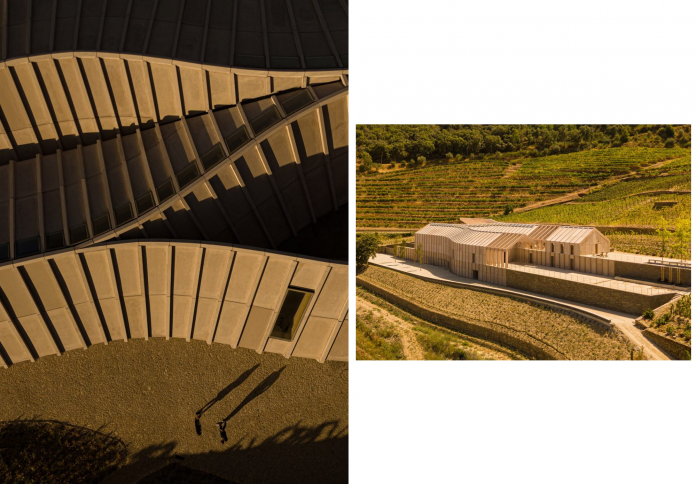
Deep in the terraced heart of Portugal’s Alto Douro, a UNESCO World Heritage site where the earth has been meticulously carved by hand for centuries, a new silhouette has emerged. Quinta de Adorigo, the latest masterwork from Atelier Sérgio Rebelo, is not merely a building but a structural echo of the landscape it inhabits. Completed in late 2024, the winery is a masterclass in “slow architecture,” defined by a sinuous timber frame that winds through the hills like a dormant giant. By marrying the ancient wisdom of gravity-fed winemaking with a cutting-edge commitment to timber construction, Rebelo has created a space that feels less like an industrial facility and more like a secular cathedral—a place where the passage of time is measured in oak barrels and shifting shadows.
The Skeleton of an Ancient Giant
The most arresting visual gesture of Quinta de Adorigo is its roof—a continuous, organic sculptural element that interprets the vernacular gable roofs of the region through a contemporary lens. Constructed from a sophisticated mix of laminated wooden frames and cross-laminated timber (CLT) panels, the interior of the main aging hall has been described by Sérgio Rebelo as reminiscent of the “skeleton of an ancient, giant animal.” This exposed timber framework doesn’t just support the building; it defines its spirit. The soaring 10-meter-high sections create a sense of spiritual verticality, inviting natural light from above to illuminate the industrial vats below with a soft, ethereal glow.

The choice of timber over traditional concrete was not merely aesthetic; it was a calculated environmental decision that reduced the project’s carbon footprint by an estimated 40%. The structure sits on a discreet concrete basement clad in local schist and granite, ensuring the building feels firmly anchored to the Douro soil. By using prefabricated glass-fiber reinforced concrete (GRC) panels produced within 150 kilometers of the site, the studio minimized transport emissions and on-site disruption. The result is a palette of pinkish browns, sage greens, and soft grays that allow the winery to “blur” with the surrounding terraces, making it difficult to distinguish where the man-made ends and the earth begins.
The Ritual of the Downward Flow
At the heart of Quinta de Adorigo lies the “gravity-flow” winemaking process, a method as old as the Roman presence in the valley. The building’s architecture is a literal manifestation of this mechanics; its interlocking naves are arranged in a downward sequence that follows the natural topographic slope. The grapes begin their journey at the highest point of the complex, dropping through circular openings into the fermentation tanks below. This vertical progression eliminates the need for mechanical pumping, preserving the delicate integrity of the fruit and reducing energy consumption.

For visitors, the journey is reversed, beginning at the lowest level in a “cave-like” wine shop and reception area. From here, a sculptural concrete staircase leads upward into the heart of the facility. This “upward discovery” allows guests to move from the cool, dark intimacy of the aging cellars to the light-filled tasting galleries above. Along the way, steel balconies and glass walls provide panoramic views of the production floor, turning the technical winemaking process into a choreographed performance. This layout ensures that the functional requirements of a high-capacity winery—capable of producing 300,000 bottles annually—never compromise the sensory experience of the visitor.
Passive Strategies and Geothermal Soul
The Douro Valley is a land of extremes, with temperatures swinging from -5°C in winter to a blistering 45°C in summer. To maintain the precise thermal conditions required for aging fine Port and table wines, Atelier Sérgio Rebelo turned to the earth itself. By partially burying the building and orienting the main façade to the north, the design utilizes the thermal inertia of the ground to keep the cellars at a steady 14 to 16 degrees year-round. This passive climate control is supplemented by a low-enthalpy geothermal system that recovers and stores energy, allowing the winery to operate on a fraction of the power required by a conventional facility.

Water management is equally rigorous. In a region where public water infrastructure is often absent, the winery functions as a self-sustaining ecosystem. Rainwater is harvested from the vast, sinuous roof, and wastewater is treated and recycled for irrigation and cleaning. Even the landscape design plays a functional role; by reviving native flora around the building, the studio has created a habitat for beneficial insects that support the health of the 24-hectare vineyard. These invisible layers of sustainability transform the architecture from a static object into a living, breathing participant in the estate’s viticulture.
A 21st-Century Monastery of Wine
The completion of the winery marks only the first phase of a broader vision for Quinta de Adorigo. Currently under construction nearby is a 25-room hotel, which Rebelo envisions as a “21st-century monastery”—a place of quiet reconnection with nature. Like the winery, the hotel will be organized as a series of fragmented volumes around a central courtyard, echoing the layout of historic Portuguese cloisters. This holistic approach to agritourism seeks to elevate the Douro experience beyond the “quick visit,” encouraging guests to linger and contemplate the deep cultural heritage of the territory.

As it stands today, Quinta de Adorigo is already a celebrated landmark, recently winning first place in its category at the World Architecture Festival. It is a building that honors the “millennia-old logic” of the Douro while unapologetically embracing the technology of the future. In the hands of Atelier Sérgio Rebelo, the winery has become a site of pilgrimage—not just for wine lovers, but for anyone who believes that architecture should be as refined, as complex, and as enduring as a great vintage. It is a testament to the idea that we do indeed “become the places we inhabit,” and in the Douro, that means becoming a part of the earth itself.