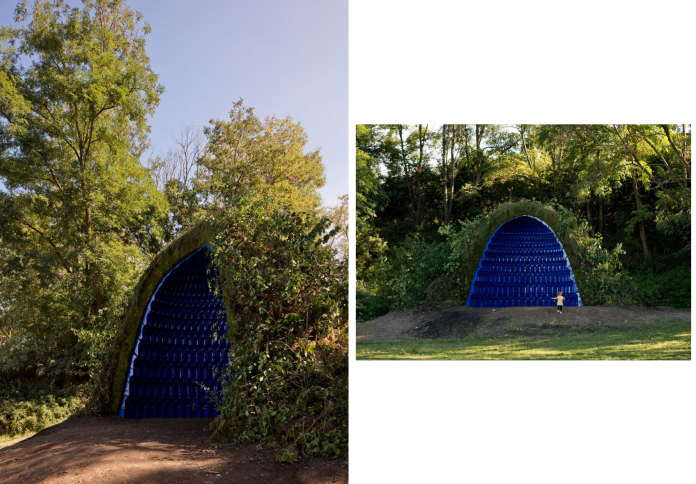
In a bold rejection of the “Secularocene”—a term describing the modern urban realm where the sacred has been systematically erased—the Paris-based architecture studio New South has unveiled a radical experiment in clay and light. The Muqarnas Pavilion, first previewed as a prototype at the CIVA in Brussels and now standing in its permanent home within the Explora Park in Saint-Étienne, is a structural manifesto for a new kind of civic space. By transforming the “muqarnas”—a traditionally ornamental honeycombed vault found in Islamic architecture—into a load-bearing, high-tech ceramic system, New South has created a “precious stone” that bridges the Global South and the Global North. Covered in turf and blooming with life, the pavilion is not just a structure; it is a sanctuary where the boundaries between the human and the non-human, the structural and the decorative, are joyfully dissolved.
Reclaiming the Sacred in the Secular City
For Meriem Chabani, co-founder of New South, the Muqarnas Pavilion is a response to the “invisibilisation and exclusion” of sacred narratives from contemporary European urban discourse. The studio argues that in secular societies, the sacred is often relegated to isolated, remote, or socially empty spaces. This pavilion seeks to bring the notion of “sacred covenant” back to the center of the public realm, suggesting that a reinvestment in the sacred can lead to processes of urban regeneration, care, and “sanctuarisation.” It is an architecture that prioritizes shared guardianship over developer-led speculation, creating a framework where communal values are valued above mere square footage.

The project is the result of a profound collaboration between New South, structural engineer Radhi Ben Hadid, and the renowned Gorbon Ceramics in Istanbul. Together, they sought to re-establish building innovation as a central tenet of contemporary Islamic architecture. Far from being a mere replica of historical motifs, the pavilion is a forward-looking research project that uses the muqarnas as a vehicle for technical discovery. It serves as a study for a larger, impending challenge: the construction of a new mosque in the 11th arrondissement of Paris, proving that ancient logic still has the power to solve modern structural puzzles.
From Ornament to Load-Bearing Logic
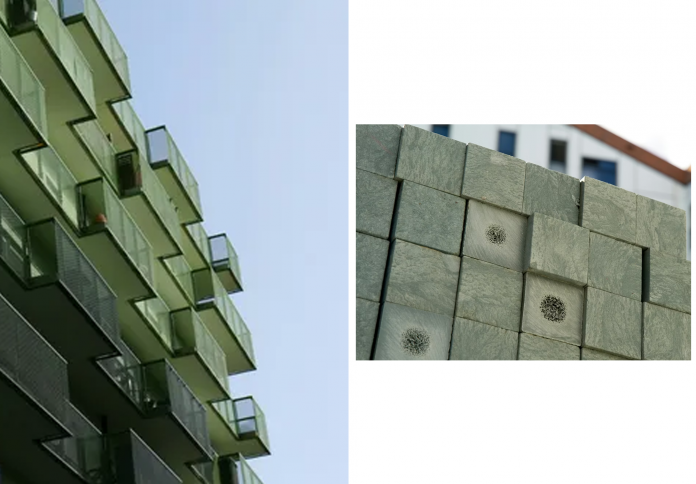
The genius of the pavilion lies in its elevation of the muqarnas from a decorative molding to a “cutting-edge structural system.” Utilizing parametric computational tools, the team designed a series of interlocking ceramic units that function like high-tech bricks. Each of the deep blue ceramic tiles, custom-fabricated by Gorbon Ceramics using a process that mixes artisanal production with digital precision, is backed with concrete to create a robust building block. These blocks are stacked to follow the logic of a catenary arch—a naturally efficient form that distributes weight evenly while creating a dramatic, self-supporting semi-dome.

These three-dimensional pieces interlock “like Lego,” reinforced with steel rebar and cellular concrete to support the weight of a living turf covering. The dimensions of each unit were meticulously refined to remain on a “human scale,” allowing them to be lifted and placed by hand—a deliberate nod to the act of manual construction. By integrating the structural and the ornamental into a single continuous surface, the architects have created a “habitat” that is simultaneously a wall, a roof, and a sculpture. This “fractal logic” ensures that the pavilion feels both immense in its complexity and intimate in its scale.
A Precious Stone Revealed from the Earth
Visually, the pavilion is designed to evoke a sense of “childlike wonder.” Chabani describes the structure as a “precious stone revealed from the earth,” comparing it to a pomegranate that has been split open to expose its hidden, intricate world. The deep blue of the ceramic tiles provides a sharp, jewel-like contrast to the rough earth and greenery that covers its exterior. This play of materials—the smooth, glazed ceramic against the organic turf—creates a “magical” atmosphere that invites visitors to pause and explore. Inside, the “stalactite” geometries of the muqarnas create a rhythmic interplay of shadow and light, transforming the interior into a meditative space.

The back of the pavilion also pays a specific tribute to Ottoman heritage through the inclusion of “bird houses,” integrated into the structure to promote cohabitation between humans and non-human life. This detail reinforces the pavilion’s mission of “care,” extending the architectural gesture to the wider ecosystem of the park. As a “stage for debates and encounters,” the space has already hosted performances and lectures, centering narratives from the Global South and providing a platform for voices that are too often marginalized in Western architectural history.
Educating the Next Generation of Makers
The final construction of the pavilion in Saint-Étienne was a pedagogical event as much as an architectural one. Built with the participation of students from the Ecole Nationale Supérieure d’Architecture de Saint-Étienne (ENSASE), the project served as a full-scale experiment in “learning by doing.” For the students, it was an opportunity to engage with knowledge from the Global South and to question the traditional hierarchies of architecture. The construction process highlighted the relationship between the profane and the sacred, encouraging a new generation of architects to think beyond the “glass box” of contemporary modernism.

As the Muqarnas Pavilion settles into its permanent home in Explora Park, it stands as a testament to the enduring relevance of “sacred architecture as a field for invention.” It proves that by revisiting historical hallmarks with contemporary technology, we can create spaces that are both structurally innovative and emotionally resonant. New South has not just built a pavilion; they have planted a seed for a more inclusive, caring, and wondrous urban future—one where the sacred is no longer a relic of the past, but a living, breathing part of the modern city.