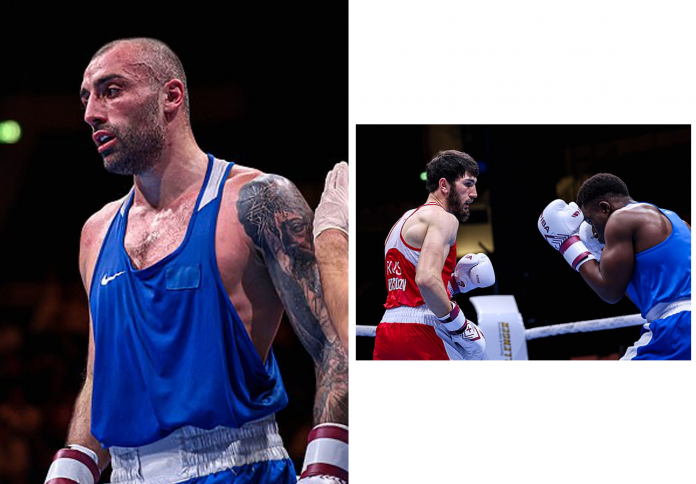
In the searing heat of the Dubai ring this December, the 2025 IBA Men’s World Boxing Championships concluded with a definitive statement of power from the traditional powerhouses of Central Asia and Eastern Europe. Held at the Dubai Duty Free Tennis Stadium, the tournament was more than just a competition; it was a masterclass in technical precision and physical resilience. With a record-breaking prize pool of over $8 million, the stakes were higher than ever, and the results solidified a familiar hierarchy. As the final bells rang, Russia, Kazakhstan, and Uzbekistan emerged as the undisputed “Big Three” of amateur boxing, turning the global stage into a showcase of their deep talent pools and unrelenting dominance.
Russia’s Golden Sweep at the Summit
Team Russia finished the 2025 championships at the absolute pinnacle of the medal table, securing a staggering 7 gold, 5 silver, and 1 bronze medal. Their performance in Dubai was characterized by tactical maturity and a “no-nonsense” style that overwhelmed opponents. A standout hero was Vsevolod Shumkov, who claimed gold in the lightweight (60kg) division after a high-stakes battle against Uzbekistan’s Abdumalik Khalokov. Shumkov’s victory was a testament to his relentless pressure and ability to maintain a high work rate over three intense rounds.
Beyond Shumkov, the Russian squad saw gold-medal triumphs from Ilya Popov (63.5kg) and the legendary Muslim Gadzhimagomedov (92kg). For Gadzhimagomedov, this victory marked his third world title, further cementing his status as one of the greatest heavyweights in amateur history. With the gold medalists taking home a massive $300,000 each, the Russian team’s haul also represented a significant financial windfall, totaling nearly $3 million in prize money—a figure that underscores the professional-grade rewards now available in the IBA circuit.
Kazakhstan: The Master of Precision
Securing the second spot on the leaderboard, Kazakhstan proved once again why they are considered a “factory” for elite pugilists. Finishing with 3 gold, 1 silver, and 2 bronze medals, the Kazakh team relied on their trademark footwork and sharp counter-punching. Saken Bibossinov led the charge in the bantamweight (54kg) category, delivering a masterclass in efficiency to outpoint his rivals and secure the gold. His performance was mirrored by Orazbek Assylkulov (57kg), who navigated a difficult bracket to stand atop the podium.
The third gold for Kazakhstan came from Ablaikhan Zhussupov (71kg), who managed to “upgrade” his previous world championship bronzes into a brilliant gold after defeating Russia’s Sergei Koldenkov. The Kazakh performance was particularly impressive given the high level of competition from neighboring regions. By consistently placing athletes in the final rounds, Kazakhstan demonstrated a structural depth that ensures they remain a formidable threat in every weight class, from flyweight to super-heavyweight.
Uzbekistan’s Ring Royalty
While Uzbekistan finished third in the gold medal count with 2 titles, they arguably showcased some of the most technical brilliance of the entire tournament, bringing home a total of 9 medals (2 gold, 4 silver, and 3 bronze). The “Uzbek King,” Hasanboy Dusmatov, reminded the world of his genius in the flyweight (51kg) final. Using his elite ring IQ and southpaw stance, Dusmatov dismantled Russia’s Bair Batlaev to retain his status as a living legend of the sport.
Joining Dusmatov at the top was Asadkhuja Muydinkhujaev (67kg), who defended his welterweight throne with a dominant 5-0 victory. Despite losing some narrow decisions in other finals—most notably the heavyweight clash between Turabek Khabibullaev and Gadzhimagomedov—the Uzbek team’s presence was felt in nearly half of the gold-medal bouts. Their performance in Dubai was a continuation of the “Uzbek era,” characterized by high-speed combinations and a defensive wizardry that continues to baffle opponents on the global stage.
A New Financial and Global Landscape
The 2025 IBA World Championships in Dubai signaled a new era for the sport, characterized by unprecedented financial incentives. The $8 million prize fund—distributed as $300k for gold, $150k for silver, and $75k for bronze—has fundamentally changed the landscape of amateur boxing. For the first time, athletes, coaches, and national federations are seeing rewards that rival professional ranks, which IBA President Umar Kremlev noted is essential for the “sustainable development” of the athletes’ careers.
As the curtains fell on Dubai 2025, the dominance of the Eastern European and Central Asian nations was undeniable. However, the rise of “emerging” nations like Azerbaijan (1 gold, 2 bronze) and the historic 5-bronze haul for Armenia suggest that the gap is narrowing. With the IBA aiming to increase the prize pool to $10 million by 2027, the world of boxing is moving toward a more professionalized and lucrative future, where the road to glory is paved with both prestige and life-changing wealth.