In a city defined by soaring steel and glass, Pritzker Prize-winning architect Tadao Ando has proposed a different kind of landmark: a sanctuary of silence and light. Revealed in late 2025, the Dubai Museum of Art (DUMA) is set to rise from a circular platform on the waters of Dubai Creek, appearing to float like a polished pearl against the desert horizon. Designed for the Al-Futtaim Group, the project marks a significant shift in Dubai’s architectural narrative, moving away from high-octane spectacle toward a more contemplative, atmospheric form of modernism. By drawing on the emirate’s maritime heritage and his own signature mastery of concrete, Ando has created a structure that whispers in a city that usually shouts, offering a five-story “cultural statement” that bridges the gap between nature and the human spirit.
A Shell Born of the Sea
The silhouette of DUMA is a radical departure from the traditional museum “cube,” taking the form of a rounded, twisting volume that mimics the organic curves of a seashell. This choice is deeply rooted in local history, paying homage to the pearl-diving industry that sustained Dubai long before its transformation into a global metropolis. The white, curving walls of the exterior are punctuated by triangular apertures that swoop upward in a spiral pattern, creating a sense of frozen movement. As the sun sets over the creek, these white surfaces are designed to absorb the shifting amber and violet hues of the sky, transforming the building into a glowing lantern on the water.

Rather than competing with the glittering skyscrapers of the nearby skyline, Ando’s design seeks a “serene dialogue” with the environment. The museum is accessed via a tree-lined walkway that juts into the creek, leading visitors toward a circular pavilion that acts as a buffer between the city and the art within. This entrance sequence is classic Ando—a transition from the chaotic external world into a space of “light, silence, and soul.” By elevating the structure on a circular platform, the architect ensures that the water remains a constant visual and acoustic presence, grounding the museum in its unique coastal context.
The Oculus: A Spine of Light
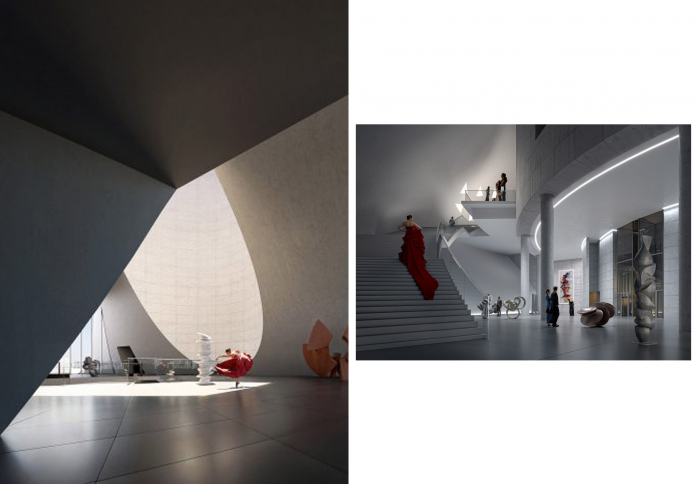
The interior of the museum is organized around a dramatic central void, a hallmark of Ando’s spatial philosophy. A soaring cylindrical oculus runs through the heart of the five-story building, drawing natural light deep into the structure. This light is intended to “shimmer like a pearl,” cascading down concrete surfaces to illuminate the walking paths and gallery spaces. This interplay of shadow and light turns the architecture itself into an experiential work of art, where the time of day and the angle of the sun fundamentally alter the visitor’s perception of the space.

Gallery spaces occupy the first and second floors, designed with Ando’s characteristic minimalism to ensure that the art remains the primary focus. These adaptable halls will host a mix of modern and contemporary works from both established international figures and emerging regional voices. By utilizing raw concrete and precise geometric volumes, Ando has created a “serene yet powerful background” that refuses to distract from the collection. The central void serves as a visual anchor, allowing visitors to maintain a sense of orientation as they move through the spiraling exhibition levels.
Beyond the Gallery: A Research Hub
DUMA is envisioned as more than just a place to view art; it is designed to be a working laboratory for the creative class. The upper levels of the museum house a library, study rooms, and specialized training areas dedicated to nurturing the next generation of curators and artists. This focus on educational infrastructure addresses a critical need in Dubai’s evolving art scene, providing the “intellectual fuel” required to sustain a long-term cultural economy. These spaces are framed by full-height glazing, offering quiet areas for reflection with panoramic views of the water and the city beyond.

The third floor is dedicated to the “social” side of the museum experience, featuring a restaurant, a VIP lounge, and a sheltered outdoor terrace. These areas are designed to host artist talks, panel discussions, and intimate gatherings for collectors and patrons. By integrating these high-end hospitality elements into the museum’s program, the Al-Futtaim Group aims to position DUMA as a central node for the international art world, particularly during the increasingly influential Art Dubai season. The terrace provides a final, breathtaking connection to the landscape, allowing the “floating” nature of the building to be fully felt.
A New Chapter for Dubai’s Culture
The unveiling of DUMA represents a milestone in the “Dubai Creative Economy Strategy,” which seeks to double the contribution of the creative industries to the city’s GDP by 2026. For Sheikh Mohammed bin Rashid Al Maktoum, the museum is a “new beacon” that reflects the city’s humanitarian mission and its openness to global creativity. It marks the transition of Dubai from a destination for shopping and entertainment to a global hub for serious cultural contemplation. The choice of Tadao Ando—an architect known for his restraint and emotional depth—is a clear signal that the city is ready for a more nuanced architectural language.

As construction begins on the banks of Dubai Creek, the museum stands as a testament to the power of public-private partnerships. It is a project that looks backward to the pearl-diving boats of the past and forward to a future where art and architecture provide the “soul” of the city. When completed, the Dubai Museum of Art will not just be another icon on the map; it will be a place where the world can pause, breathe, and witness the silent dance of light on concrete. Ando has once again proved that in the right hands, architecture can be a masterpiece of restraint, capturing the invisible depth that lies beneath the surface of the modern city.