On the sun-drenched sands of Faena Beach during Miami Art Week 2025, a curious structure emerged that blurred the lines between a laboratory and a sanctuary. “Plant Pulses,” a multidisciplinary installation by Polish designer Marcin Rusak in collaboration with Maison Perrier-Jouët, invited visitors to step out of the frantic pace of Design Miami and into the secret, ultrasonic world of plants. By translating the inaudible stress signals of vines into a rhythmic landscape of light and sound, Rusak has created a “contemporary herbarium” that makes the invisible visible. It is a work that honors the Art Nouveau heritage of the storied Champagne house while utilizing cutting-edge science to explore the fragile resilience of the Champagne terroir.
Decoding the Secret Language of Vines
The conceptual heart of Plant Pulses lies in a startling scientific discovery: plants “talk” when they are thirsty. Working with researchers Bartek and Klara Chojnacki from the AGH University of Kraków, Rusak utilized recordings of ultrasonic pulses emitted by plants during periods of dehydration. These signals, normally far beyond the range of human hearing, manifest as a sharp, rhythmic “tick” that intensifies as the plant experiences environmental stress. For Rusak, hearing these translated recordings was a transformative experience that shifted his perception of the botanical world from a passive background to a reactive, communicating presence.

The installation transforms this raw data into a three-part immersive soundscape that guides visitors through a narrative of stress and recovery. The audio begins with sharp, urgent pulses representing dehydration, transitions into a phase of inter-plant communication, and eventually softens into a rhythmic, melodic flow as the plants are “rehydrated.” This sonic architecture allows the public to empathize with the biological reality of the vineyard, turning abstract ecological data into a visceral, emotional experience that underscores the sensitivity of the living world.
A Time Capsule of the Champagne Terroir
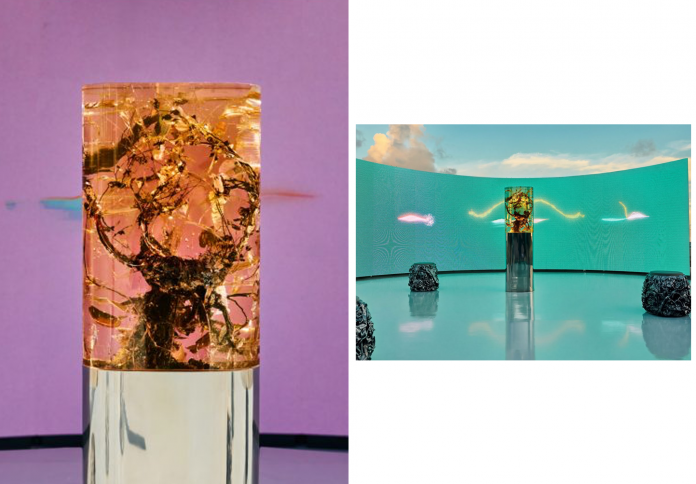
At the center of the installation stands a monumental, resin-encased sculpture—a “modern herbarium” that functions as a physical record of Perrier-Jouët’s ecosystem. Developed in Rusak’s Warsaw studio, the piece embeds three “hero plants” (axiophytes) identified by the Maison’s biodiversity experts: the vine, European birthwort, and white clover. These species are critical indicators of soil health in the Champagne region. By suspending these plants in clear resin alongside actual chalk soil from Épernay, Rusak has created a “time capsule” that preserves the identity of a landscape currently threatened by the rapid shifts of climate change.

The sculpture is surrounded by a ring of digital screens that display animated graphics evolving in tandem with the soundscape. These visuals shift from stark, geometric lines during the “stress” phase into soft, organic, bubble-like forms that subtly nod to the effervescence of Champagne. This interplay between the frozen, preserved botanical matter and the dynamic, digital representation of plant life creates a powerful dialogue between the past, the present, and a speculative future. It is a reminder that the luxury of the future is inextricably linked to the preservation of the land.
Craftsmanship in the Age of Regeneration
In keeping with Perrier-Jouët’s Art Nouveau roots, where nature is seen as the ultimate source of inspiration, the installation prioritizes the beauty of materiality. The 3D-printed seating that invites visitors to linger is coated with dried plant matter collected directly from the vineyards in France. This tactile detail brings the physical essence of the terroir to the shores of Miami, grounding the high-tech installation in a centuries-old tradition of craftsmanship. Rusak’s signature resin technique, which he has spent a decade refining, is used here not just for its aesthetic quality, but as a tool for “scientific storytelling.”

This collaboration is more than just a seasonal activation; it is part of a long-term vision for regenerative viticulture. Perrier-Jouët has committed to converting 100% of its vineyards to regenerative practices by 2030, and the research behind Plant Pulses—specifically the monitoring of plant stress signals—may eventually inform real-time water management and resource allocation in the fields. By funding such ambitious artistic research, the Maison is proving that art can be a catalyst for meaningful environmental innovation, turning “joyful beauty” into a strategic tool for ecological survival.
The Design for Nature Legacy
The Miami premiere of Plant Pulses also served as the backdrop for a major cultural announcement: the launch of the inaugural Perrier-Jouët “Design for Nature Award.” This annual prize recognizes designers whose work addresses sustainability through an Art Nouveau lens, emphasizing the harmony between human intervention and the natural world. The first award was presented to the pioneering Dutch haute couturier Iris van Herpen, whose work—much like Rusak’s—explores the fluid boundaries between technology and the organic. Van Herpen will debut a major commission inspired by this collaboration at Design Miami 2026.

As the sun sets over Faena Beach, the glowing screens of Plant Pulses continue their rhythmic dance, a silent tribute to the secret lives of the vines thousands of miles away. Marcin Rusak has succeeded in creating a space where we can finally “listen” to the earth, proving that the most profound messages are often the ones we cannot hear without help. In the fragile silence between the pulses, the installation leaves us with a haunting question: if the plants are speaking, are we truly ready to hear what they have to say about the future of our planet?