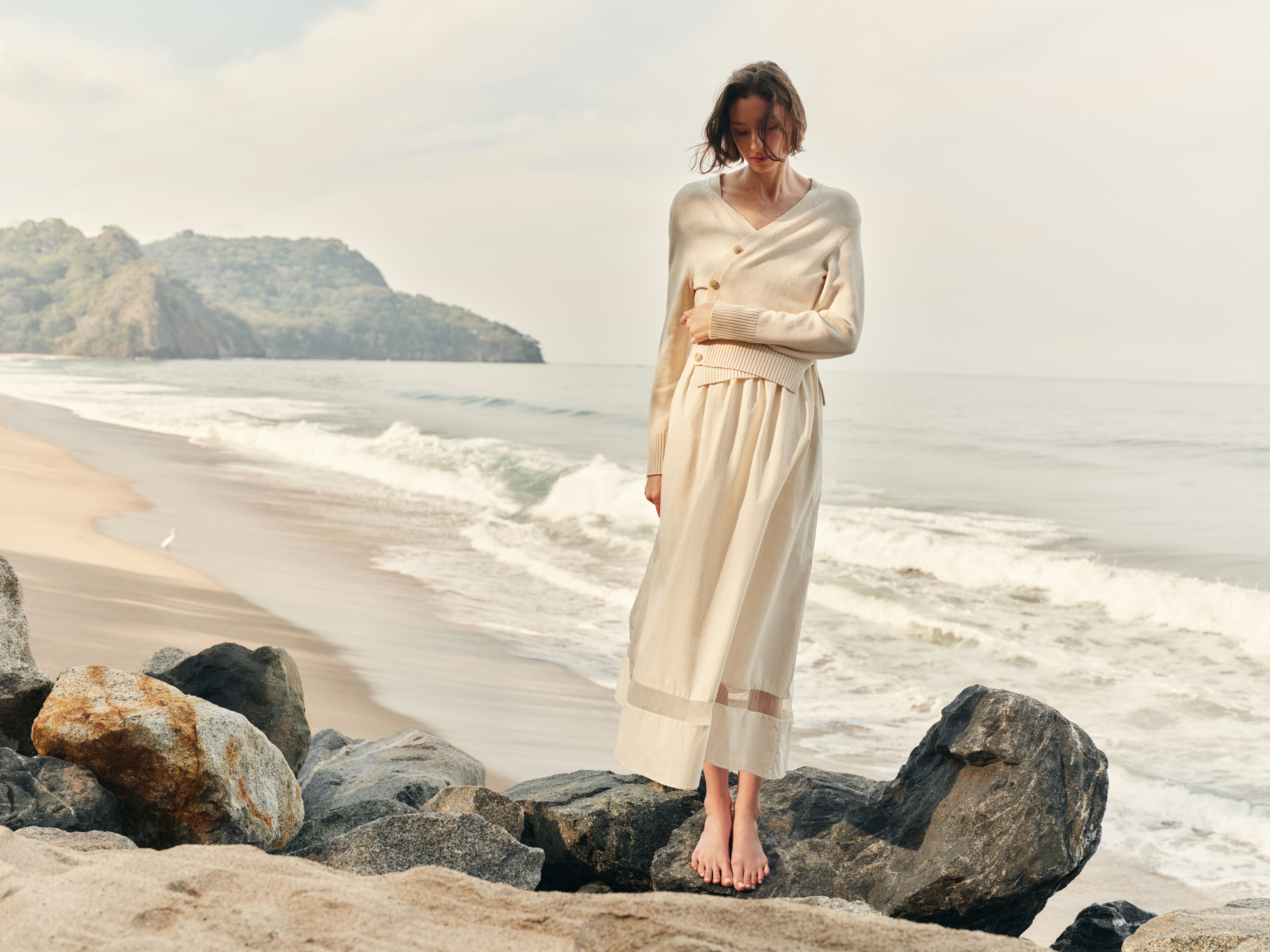
Jenni Kayne’s Pre-Fall 2026 collection uses light layers to accommodate the different temperatures that can share a single day. Cotton, linen, cashmere, and fine merino give the wardrobe several ways to add or remove warmth, while the campaign’s beachfront setting at Rosewood Mandarina keeps summer visibly present. Horses and landscape supply atmosphere, but the clothes remain relatively restrained: cardigans, dresses, and lightweight knits are arranged to work together. The collection’s interest lies in that practical continuity. A warm afternoon and a cooler morning may belong to the same day, and a wardrobe can respond without demanding two separate versions of the person wearing it. Layering becomes a method of adjustment, with material and proportion doing more work than seasonal spectacle.
The Beach Keeps Summer in the Frame
Rosewood Mandarina gives the campaign a setting where pre-fall does not have to look like autumn leaves or a heavy coat. Beachfront scenery and horses create a recognizable atmosphere of outdoor ease. The landscape is part of the image, but it should remain distinct from the clothes’ practical claims. A garment photographed beside the sea does not automatically become appropriate for every climate. The setting presents one interpretation of the collection, leaving actual wear to depend on a person’s weather, routine, and preferences.
That separation is useful because transitional dressing is often discussed as though a season changes everywhere at once. In practice, a collection’s calendar and a wearer’s environment may not match neatly. Kayne’s lightweight materials acknowledge that gap. Summer can remain present while a sweater becomes useful at another hour. The campaign’s beach therefore offers more than a scenic backdrop: it keeps warmth in the picture while the clothes introduce ways to modify it, avoiding the assumption that pre-fall must already behave like winter.
A Cardigan Adds an Adjustable Boundary
The Sunset cardigan uses a boxy shape and rib-stitch texture. Its proportions create space around the upper body, giving the ribbed layer a clear outline around the upper body. A cardigan also allows several degrees of closure. Open, partly fastened, or closed, it changes the relation between the layer underneath and the garment’s own surface. That adjustability gives the object a practical role in a wardrobe expected to respond to shifting conditions.
Rib stitch makes the surface more legible within a restrained palette. A plain knit can read as a flat field in a photograph; repeated ridges introduce a small rhythm that catches light differently across the fabric. The cardigan’s texture can therefore provide detail without requiring a large print or ornamental contrast. Its boxy shape and material work together, keeping the piece visually substantial while allowing it to sit beside a dress, trouser, or skirt with a different degree of fluidity.
Fine Merino Changes the Amount of Warmth
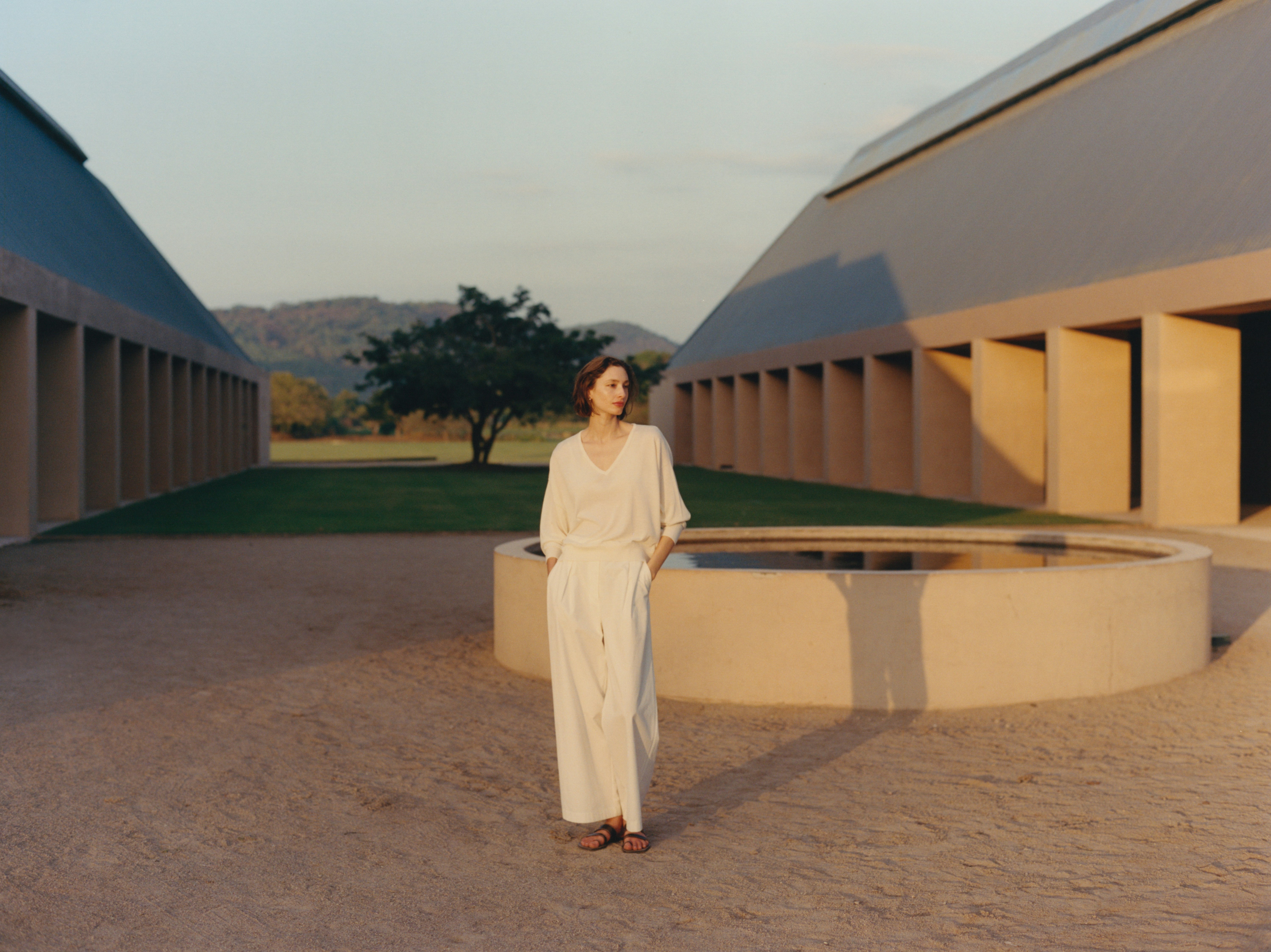
The Dree V-Neck uses fine merino wool, offering another layer in the collection’s transition between seasons. A lightweight knit occupies a different place from a thick sweater. It can add coverage without creating the same volume, allowing an outfit to retain a relatively close or fluid line. The fine knit changes the amount of material carried around the body, with warmth still depending on the wearer and the day. Different wearers and climates will still determine how much warmth is useful on a given day.
A V-neck also changes the visible relation between the sweater and the layer below. The opening can reveal a neckline or create a clear interval around the neck, preventing the knit from closing the upper body completely. In a wardrobe built from understated pieces, those small differences carry much of the styling. A cardigan’s front, a sweater’s neckline, and a dress’s edge can organize the composition without needing each garment to declare a separate dramatic identity.
Linen and Cotton Let the Layers Breathe Visually
Cotton and linen keep the collection connected to summer dressing. Their appearance can be relatively relaxed, particularly beside the clearer texture of a ribbed knit. Pairing a fluid dress with a cardigan makes the contrast visible: one garment falls, while the other gives the upper half a more defined boundary. The combination is familiar, but its effectiveness depends on length and proportion. A layer that ends at one point on the body can make the same dress look quite different from a longer layer over it.
Kayne’s approach does not require every item to match in texture. The wardrobe can gain interest through a controlled difference among surfaces: linen, cotton knit, fine wool, and cashmere respond to light and movement in their own ways. A restrained color palette makes those differences easier to notice. The absence of a loud pattern is therefore not the absence of design. Material carries information, and the wearer’s movement brings that information into a setting beyond the campaign photograph.
Layering Is a Sequence of Small Decisions
An outfit assembled for a warm afternoon may need only one additional layer when the temperature changes. That practical adjustment is a more specific proposition than the broad language of timeless essentials. The wardrobe works through relationships among pieces: how a cardigan sits over a dress, whether a fine sweater fits beneath another layer, and how the whole arrangement changes when something is removed. Removing the cardigan reveals whether the dress still holds the outfit together; adding the fine sweater tests another combination.
The collection’s restrained silhouettes make those tests easier to imagine. The garments do not all compete to be the principal image, leaving room for one piece to support another. A cardigan can organize the upper body while a dress supplies movement below it. A lighter knit can extend the day’s use of an existing outfit. The purpose is continuity with adjustment, a form of dressing that acknowledges changing conditions without treating the previous hour’s clothes as suddenly obsolete.
Back at the campaign’s beachfront setting, the horses and horizon establish a mood that will not accompany most wearers through an ordinary day. The clothes have to travel farther than the image. Their most persuasive destination may be a less spectacular setting: a morning cool enough to need a cardigan, followed by an afternoon in which it can be folded over an arm. The collection gives that small change a considered shape.