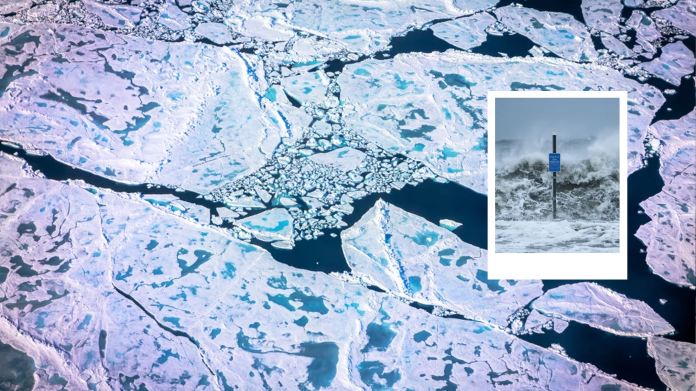
A dramatic weakening—or even collapse—of the Atlantic Meridional Overturning Circulation (AMOC) could bring Europe to its knees with freezing winters, shifting storms, and crop failure, even in a world warmed by climate change. A groundbreaking new study maps this chilling future and challenges assumptions about a uniformly hotter planet.
The ocean current holding back an ice age
The Atlantic Meridional Overturning Circulation, or AMOC, is one of Earth’s most vital systems. Acting like a planetary conveyor belt, it transports warm water from the tropics northward and returns colder, denser water southward. This balance of heat and salinity keeps Europe’s winters mild, stabilizes weather patterns, and regulates sea levels on the eastern seaboard of North America.
But recent studies are painting a grim picture: the AMOC is weakening. Scientists warn that rising global temperatures and melting polar ice are disrupting the salinity and temperature gradients that keep it functioning. If this circulation slows drastically—or collapses entirely—its absence could trigger extreme, long-lasting climate shifts across the globe.
Now, for the first time, scientists have modeled in detail what might happen if the AMOC collapses in a world already warmed by human-induced climate change. The results, published in Geophysical Research Letters, are stark.
A colder Europe in a hotter world

The study, led by researchers at Utrecht University in the Netherlands, simulated a future in which the AMOC weakens by 80% while global temperatures are approximately 2°C above pre-industrial levels. This level of warming could realistically occur within a few decades if greenhouse gas emissions continue unchecked.So, what happens when warming and cooling forces collide?
“Does the cooling win or does the warming win?” asks co-author René van Westen, a marine and atmospheric scientist. The findings suggest that while global warming heats much of the world, Europe could face a paradoxical deep freeze—particularly during winter.
The collapse would cause sea ice to advance southward toward northern Europe, reflecting sunlight and amplifying local cooling. Average winter temperatures across the continent would plunge. Cities like London could face cold snaps with lows around -2.2°F, while Oslo could endure winter lows of -55°F. Parts of the continent would remain below freezing nearly half the year.
Increased cooling wouldn’t just affect temperatures—it would also alter Europe’s weather dynamics. With a heightened contrast between cold northern air and warmer southern air, storm systems would intensify. Northwestern Europe, in particular, could see stronger, more frequent storms, the researchers warn.
Beyond frostbite: Societal and ecological collapse
While cooling might seem like a relief in the age of global warming, van Westen emphasizes that the effects would be “anything but good news.”
Europe, like much of the Northern Hemisphere, is built for a temperate climate. Infrastructure, agriculture, and energy systems are not designed to withstand prolonged sub-zero temperatures. Crops would fail, food systems could falter, and power grids would face surging demand for heating. The continent could find itself battling freezing winters and deadly summer heatwaves in the same year.
And the pain wouldn’t stop at Europe’s borders. The weakening AMOC has already been linked to accelerated sea level rise along the northeastern coast of the U.S., causing flooding in cities like New York and Boston. With a full collapse, this effect could worsen dramatically. Meanwhile, the Southern Hemisphere is projected to continue warming, exacerbating global climate inequalities. Van Westen’s team also modeled an even hotter future—around 4°C above pre-industrial levels. In that scenario, the warming effect overwhelms the regional cooling from an AMOC collapse. But even then, Europe experiences heightened climate volatility, with colder winters and hotter summers.
A storyline not yet written—but worth fearing
Though the new study provides the clearest picture yet of what an AMOC collapse might mean, it relies on a single, albeit advanced, climate model. Other models may paint different pictures. That uncertainty has fueled debate among scientists, some of whom urge caution in over-interpreting results from any one simulation.
“This study is by no means the last word,” says Richard Allen, a climate scientist at the University of Reading in the UK who was not involved in the research. “But even the mere possibility of this dire storyline unfolding over coming centuries underscores the need to forensically monitor what is happening in our oceans.” Indeed, the timing of a potential collapse remains one of the biggest unknowns. Some projections suggest it could occur as soon as this century. Others believe it’s centuries away. But all agree: once the AMOC crosses a tipping point, recovery may be impossible within human timescales. “The AMOC is like a giant boulder on a hill,” says Stefan Rahmstorf, a physical oceanographer at Potsdam University in Germany. “Once it starts rolling, you can’t stop it.”
Rethinking climate resilience
One of the most urgent implications of this research is for policy planning. “Right now, most strategies are built around the idea of a warmer future,” van Westen says. “But we may need to also prepare for a colder one.”
That includes designing infrastructure capable of withstanding not just heat waves but extreme cold. It also means updating agricultural models, power grid plans, and emergency preparedness systems. Without such adjustments, Europe and parts of North America could find themselves dangerously unprepared. The team has even developed an interactive global map to visualize how an AMOC collapse would reshape temperature patterns around the world. It’s not just a scientific tool—it’s a wake-up call.
Avoiding the unthinkable
The good news? We may still have time to avert this scenario. While the AMOC appears to be weakening, it hasn’t yet collapsed. Cutting greenhouse gas emissions and slowing polar ice melt could help preserve its stability. But the window is narrowing. As van Westen puts it, “We want to avoid this at all costs.”
The AMOC has served as Earth’s silent climate regulator for thousands of years. Whether it continues to do so depends on decisions we make in the next few decades. If we ignore the warnings, we may face a climate story not of steady warming—but of sharp, sudden shock.