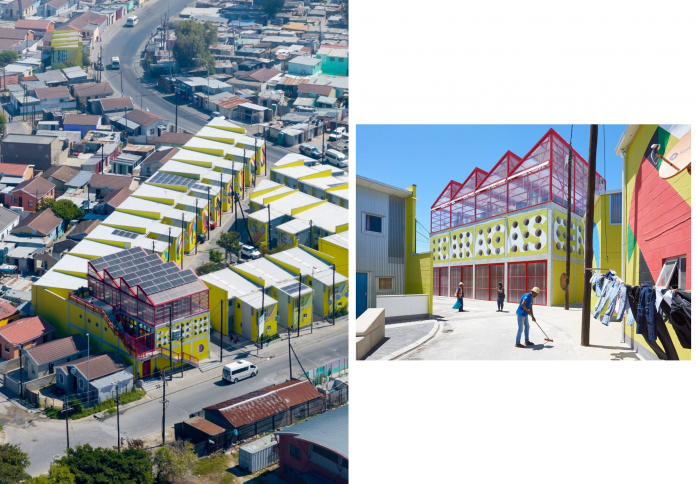
In the heart of Site C in Khayelitsha, one of South Africa’s largest townships, a new architectural landmark has emerged as a symbol of resilience and collective agency. Completed in early 2026 by the non-profit Urban-Think Tank Empower (UTTE), the Soweto-Caracas Community Centre is a vibrant, multi-functional hub that crowns a decade-long effort to transform informal settlements. Distinguished by its “sawtooth” rooftop greenhouse and a bold palette of red and yellow, the centre is the social anchor of the BT-Soweto development, a project that replaced 72 shacks with dignified, high-density terrace housing. By integrating sports, education, and urban farming into a single 320-square-meter footprint, the centre challenges the notion that high-quality design is a luxury, asserting instead that it is a fundamental tool for socio-economic empowerment in the global south.
A Beacon of Social Infrastructure
The Soweto-Caracas Community Centre was designed to address a critical vacuum of social services in the Khayelitsha township. UTTE architectural director Benjamin Kollenberg described the project as a “beacon”—both a literal one, as its illuminated rooftop greenhouse glows at night, and a metaphorical one, providing a safe space for communal growth. The building’s form is a direct response to its compact, triangular site, driving a design that packs an immense amount of programming into a limited area. From the street, the building’s bright yellow walls and porthole windows offer a cheerful, unmistakable presence that mirrors the energy of the surrounding neighborhood.
At its core, the project is about “good densification.” Unlike traditional government housing projects that often relocate residents to far-flung outskirts, the Empower model allows communities to remain on their ancestral land while upgrading their living conditions. The community centre acts as the keystone of this ecosystem, providing the shared amenities that individual homes cannot. It is a space designed not just to be looked at, but to be used intensely, serving as a daycare by morning, a sports arena by afternoon, and a town hall by evening.
The Multi-Functional Sports Core
The focal point of the interior is a double-height sports hall, a versatile volume designed to accommodate everything from five-a-side football to netball and large-scale community gatherings. The hall features a brightly colored, high-performance floor and removable sports equipment, allowing the space to be cleared for events or workshops in minutes. Sliding metal doors at the ground level enable the hall to spill out onto the street, blurring the line between the building and the public realm and encouraging spontaneous interaction.
Above the hall, a red-finished balcony provides a vantage point for spectators, while rows of porthole windows puncture the upper walls to flood the space with natural light. This design ensures that the hall feels open and airy despite its robust, secure construction. The architects deliberately chose materials that are both durable and locally relevant—concrete block cavity walls and corrugated cladding—ensuring that the building can withstand heavy use while remaining easy for the community to maintain and repair over the long term.
The Productive Roof: Greenhouse and Energy
Capping the structure is a striking sawtooth greenhouse framed in red steel and clad in translucent polycarbonate panels. This rooftop farm is more than an aesthetic flourish; it is a vital engine for food security and economic independence. Managed by community members, the greenhouse utilizes aquaponic systems to produce organic vegetables and fish, providing both nutrition for local families and a source of income for the centre’s ongoing operations. The “sawtooth” shape is functional as well as iconic, optimized for passive ventilation and maximum solar exposure.
The roof also serves as the centre’s power plant. Covered in a sophisticated array of photo-voltaic (PV) panels, the building operates entirely off-grid, independent of South Africa’s often-unreliable national energy supply. This solar microgrid provides lighting not only for the centre itself but also for the surrounding public spaces, improving safety in the neighborhood at night. By combining renewable energy with urban agriculture, UTTE has created a prototype for climate-resilient architecture that empowers residents to become producers rather than just consumers.
A Collaborative Legacy
The inauguration of the Soweto-Caracas Community Centre marks the culmination of years of participatory design. UTTE worked closely with the residents of Site C, local NGOs like Ikhayalami, and international partners to ensure that every aspect of the building met the community’s specific needs. This collaborative approach extended to the construction phase, where 50% of the labor was recruited from the local community. This not only provided immediate jobs but also fostered a sense of ownership and pride, ensuring that the building would be treated as a collective asset rather than an external imposition.
Ultimately, the Soweto-Caracas Community Centre is a testament to the power of “Architecture of Equity.” It proves that with thoughtful planning and community buy-in, even the most marginalized urban areas can be transformed into vibrant, sustainable neighborhoods. As UTTE prepares to scale this model to other townships across South Africa, the centre stands as a colorful, resilient reminder that dignified housing and social support are the bedrock of a truly democratic future.