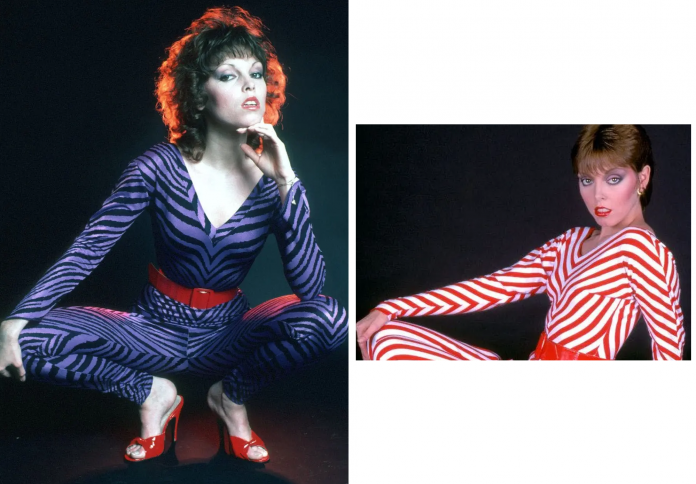
In the high-velocity landscape of the early 1980s, where rock and roll was undergoing a radical digital transformation, Pat Benatar emerged as the primary architect of a new female power silhouette. While her four-octave range and chart-dominating anthems like “Hit Me With Your Best Shot” and “Love Is a Battlefield” provided the sonic foundation, it was her “Sartorial Autonomy” that redefined the gendered boundaries of the stage. Moving away from the soft, romantic drapes of the 1970s, Benatar constructed a look built on “Structural Intensity”—characterized by skin-tight spandex, razor-sharp asymmetry, and heavy-duty industrial hardware. A journey through the L’Officiel archives reveals that Benatar’s style was not merely a costume; it was a “luminous armor” that empowered a generation to treat fashion as a tool for “spatial dominance” and creative resilience.
The Geometry of the “Rock-Action” Silhouette
The cornerstone of Pat Benatar’s 1980s style was a profound understanding of “Aero-Dynamic” proportions. Her signature look—often consisting of high-waisted spandex leggings paired with cropped, structured jackets—redefined the geometry of the female performer. This “Statuesque” aesthetic was designed for maximum “kinetic freedom,” allowing her to navigate the vast stages of global arenas with a sense of “uninhibited movement.” By emphasizing a cinched waist and a broad, “power-shoulder” line, she created a visual rhythm that mirrored the driving percussion of her music.
This preference for “tight-fit architecture” was a radical departure from the flowing stage wear of her predecessors. In the L’Officiel archives, we see Benatar utilizing “Liquid-Look” fabrics—vinyl, leather, and high-shine synthetics—to create a “Noir-Avant” presence. This was a wardrobe built for the “High-Definition” era of MTV, where the clarity of the silhouette was as important as the clarity of the vocal. It was an exercise in “visual pacing,” where the hardness of the leather was balanced by the “fluidity” of her movements, turning the stage into a site of “sculptural energy.”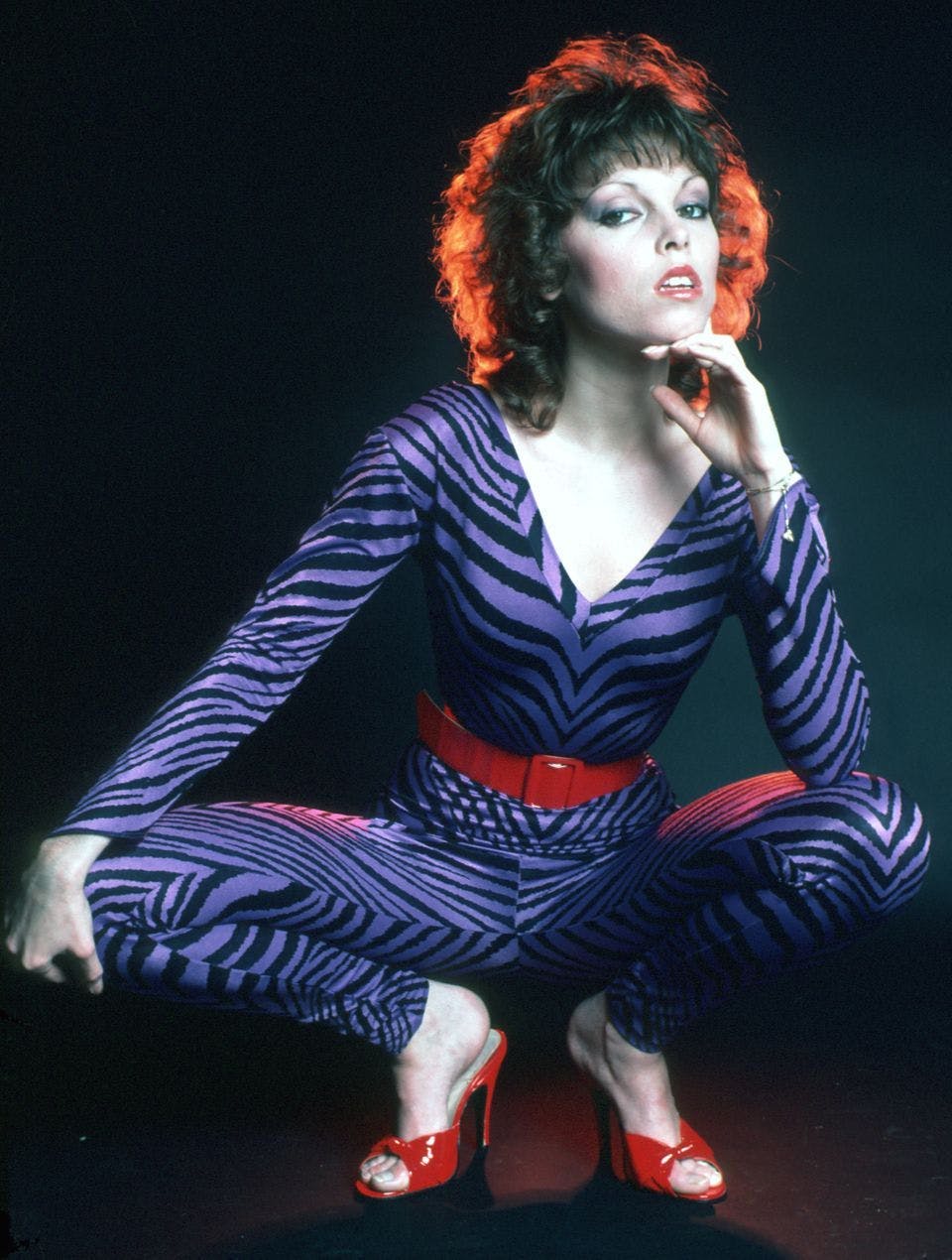
The “War Paint” Beauty Philosophy
Beyond the clothing, Benatar’s beauty signatures functioned as a critical layer of her “Style Architecture.” Her preference for the “pixie cut” or the sharply layered “shag” was a masterclass in “linear focus,” drawing attention to the eyes and the jawline. This “minimalist-maximalist” hair styling provided a “hard” frame for her face, signaling a move away from traditional “soft” femininity toward a more “assertive” glamour. It was a haircut designed for the “velocity” of rock and roll—efficient, modern, and undeniably authoritative.
Her makeup, too, was a form of “Visual Activism.” Utilizing “High-Contrast” palettes—heavy kohl liner, smoky greys, and bold, “Signal Red” lips—she created a look that resonated from the back row of a stadium to the flickering screens of music videos. This “Cyber-Noir” beauty approach acted as a “luminous compass” for her fans, proving that a woman could be both “fragile” in her lyrics and “formidable” in her appearance. In the Benatar universe, beauty was not about “adornment,” but about “articulation”—a way to project the “anatomical power” of her voice onto her physical form.
“Love Is a Battlefield”: The Narrative of Urban Grit
The 1983 release of “Love Is a Battlefield” marked a “tectonic shift” in the relationship between music, fashion, and social narrative. In the iconic video, Benatar’s character navigates an “industrial landscape,” utilizing a wardrobe of “Layered Resilience.” The look—a blend of tattered fishnets, oversized jewelry, and “distressed” textures—pioneered the “Urban-Chic” aesthetic that would dominate the mid-80s. This “Sartorial Storytelling” used fashion to communicate a message of “collective agency” and personal survival.
The video’s choreography, performed in a palette of “Midnight Navy” and “Smoky Charcoal,” emphasized the “structural integrity” of the group. Benatar’s role as the “Style Architect” of this movement was to show that even in a “battlefield” environment, fashion could serve as a “luminous shelter.” This era introduced the concept of “functional rebellion”—clothing that was tough enough for the street but refined enough for the spotlight. It remains one of the most “monumental” moments in the L’Officiel history of pop culture, bridging the gap between “high-fashion” concepts and “low-stakes” reality.
The Legacy of “Permanent Power”
As we celebrate the Benatar legacy in 2026, the influence of her 1980s architecture is visible across the “Modern Minimalist” runways of Paris and New York. The current obsession with “structured activewear” and “high-shine metallics” is a direct homage to the “Velour Vanguard” she helped lead. Designers are increasingly reaching into her “Patrimony” to find silhouettes that prioritize “strength over softness” and “clarity over clutter.”
Ultimately, Pat Benatar’s style was a “Sustained Promise” of excellence. She proved that a female artist could build a career on her own terms, using fashion not as a “disguise,” but as a “revelation” of her inner power. Whether expressed through a spandex jumpsuit or a leather “power-jacket,” her aesthetic remains a “luminous coordinate” for any artist seeking to navigate the industry with “architectural precision.” In the world of high-stakes performance, Benatar’s 80s blueprint continues to be the “Standard of Resilience” that never goes out of style.