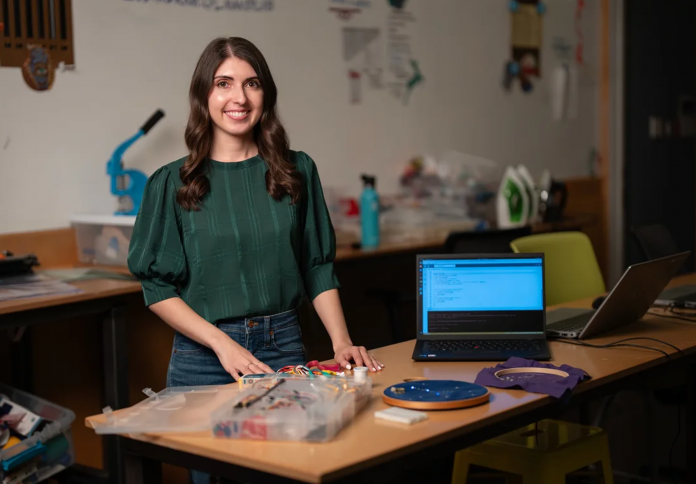
In Chicago, software engineer Christina Ernst is transforming fashion into a fantastical frontier of technology. With twirling gowns, AI-powered accessories, and glowing corsets, her self-coded creations blend engineering with storytelling—inviting a new generation of girls into the world of STEM, one circuit at a time.
Engineering fantasy into fabric
When Christina Ernst imagined a dress that could twirl on its own, she didn’t stop at the concept. She built it, coded it, and brought it to life. The resulting robotic gown, with its hem lifting and spinning on command, was only the beginning of her “fashioneering” journey—her term for the fusion of fashion and engineering.
Since then, Ernst has created glowing cathedral gowns with light-up stained-glass panels, corsets flickering with faux candlelight, and even a Medusa costume adorned with serpents powered by artificial intelligence. These creations, both playful and intricate, have captivated an online audience of hundreds of thousands. By day, Ernst works as a software engineer at Google’s Chicago office. By night, she brings her imagination to life through fabric, wires, and code, sharing her projects on social media and her platform She Builds Robots.
What makes Ernst’s work so compelling isn’t just the technical mastery—it’s the wonder. “Technology really is magical to me,” she said. “When I say I make robotic dresses, I never want it to look how people expect it. The wonder and the whimsy are very important.”
Reimagining STEM through style
Ernst’s work is more than wearable tech—it’s an open invitation to young people, especially girls, to see themselves in STEM. Through tutorials, classroom kits, and hands-on workshops, she shows that science and creativity aren’t opposites—they’re deeply intertwined.
“When I was growing up, I would have loved to see some sort of tech representation for my interests in fashion, art and drawing,” Ernst said. “It’s really important to me to center my tutorials on the interests a lot of teen girls already have, to meet them where they are.”
The spark came early. At a college hackathon, Ernst built a Bluetooth-controlled LED dress that changed colors on command. The overwhelming interest from girls asking how to build their own version was, as she puts it, a “lightbulb moment.” Since then, her mission has been to bridge the perceived divide between creativity and coding. Her efforts include free online guides, circuit-focused art projects, and even distributing educational kits to Chicago public schools.
“A lot of people think fashion is completely divorced from the sciences, but that is not true at all,” she explained. “The history of the computer is actually textile history. The Jacquard loom used binary punch cards—it’s one of the early foundations of computing.”
From viral rats to rising phoenixes
While some of Ernst’s creations evoke fairy-tale wonder, others are gleefully absurd. Her most viral project to date is a headband featuring a 3D-printed “Remy” from Ratatouille, whose robotic paws tug at her hair as she chops onions in her kitchen—a reference to the beloved Pixar scene. To make it work, she coded randomized arm movements, then later upgraded it using an accelerometer synced to her head motions after a flood of viewer suggestions.
This dialogue with her audience—especially around prototypes and failure—is part of what sets Ernst apart. “I was surprised by how many people have commented that they like seeing the failures,” she said. “They like seeing the prototypes that don’t work. It helps them see that it’s OK to fail and OK to iterate—nobody inherently knows how to do these things.”
One of her latest projects, created during a 12-week residency at the Chicago Public Library’s Maker Lab, was a gown inspired by the Garden of the Phoenix. The ethereal dress features gold and blush feathers that rise and fall when passersby wave their hands near a panel, thanks to a system of photoresistors. Originally, Ernst had planned to use motion sensors or smartphone triggers, but as with many of her designs, she adapted based on available tools and tight deadlines. “It’s all trial and error,” she said. “I’ll go through six, seven, even eight prototypes before I get close to something that works.”
More than fashion: A movement
While robotic fashion has made high-profile appearances on global runways—Alexander McQueen’s spray-painting robots in 1998 and Coperni’s robot dogs in 2022—Ernst’s work isn’t about spectacle or trend. Instead, it’s about accessibility, playfulness, and empowerment. Her designs may not be meant for mass production or couture catwalks, but they serve a broader purpose: reframing how we see technology, and who gets to use it. “I’m not trying to predict the future of fashion or tech,” Ernst said. “I just want to show people a new way of thinking—especially young makers who haven’t yet seen themselves in engineering.”
In every LED stitch and servo motor lies a message: you don’t have to choose between art and science. With the right tools—and a healthy dose of imagination—you can make magic.
Christina Ernst is not designing dresses for the runway. She’s designing doorways—into science, into creativity, and into a future where young girls can see themselves as engineers, artists, or both. Her fantastical gowns, part performance, part prototype, offer a refreshing reminder that innovation thrives when it’s playful, inclusive, and brave enough to be a little weird. In Ernst’s world, whimsy isn’t a distraction from engineering—it’s the spark that powers it.