In the rapidly evolving landscape of Downtown Brooklyn, where glass-clad towers often compete for vertical dominance, a new residential skyscraper has emerged with a decidedly different tonal ambition. “The Brook,” a 52-story mixed-use tower designed by the renowned American firm Beyer Blinder Belle (BBB), serves as a refined anchor for one of the borough’s most complex and heavily trafficked intersections. Situated at the confluence of DeKalb Avenue, Flatbush Avenue, and Fulton Street, the building occupies a unique, triangular “flatiron-like” site that challenges conventional high-rise massing. By eschewing the monolithic transparency of its neighbors in favor of deep masonry-inspired metal tones and stepped setbacks, The Brook seeks to elevate the Brooklyn skyline while remaining firmly rooted in the historical materiality of the borough it calls home.
Geometry and the Flatiron Legacy
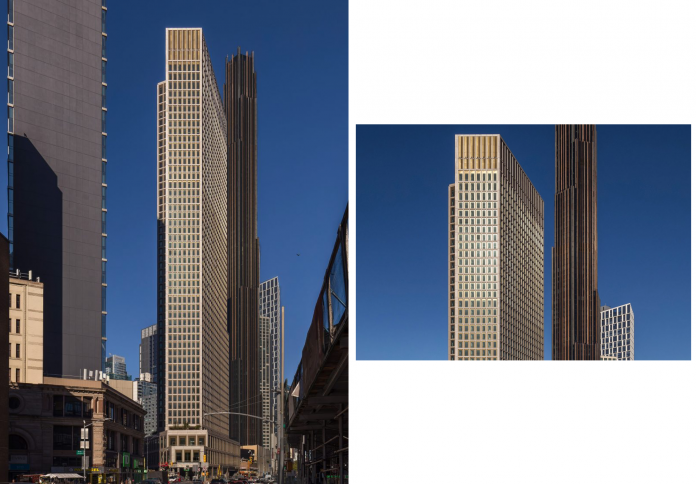
The architectural identity of The Brook is inextricably linked to the triangular geometry of its site. Beyer Blinder Belle utilized this challenging footprint to create a building that functions as a visual gateway to Brooklyn’s central business district. The tower rises to a height of 600 feet, but its mass is softened by a series of deliberate setbacks along the base and the Fulton Street facade. These stepped tiers serve a dual purpose: they break down the building’s overall scale at the pedestrian level and create a necessary visual separation from its immediate neighbor, the soaring Brooklyn Tower.
According to the architects, these setbacks ensure that The Brook offers a “different visual experience” from every angle. From the north, the tiered massing responds to the acute angles of the intersecting streets, culminating in a distinct crown that punctuates the skyline. This geometric playfulness allows the 591-unit building to feel less like a rigid block and more like a sculptural insertion into the urban fabric, proving that high-density residential architecture can be both efficient and expressive when tailored to the specific constraints of the New York street grid.
Materiality vs. Transparency
In a district increasingly defined by “all-glass” high-rises, Beyer Blinder Belle made a conscious decision to return to a more traditional architectural palette. The facade of The Brook features punched windows set within eight-inch-deep aluminum-composite metal frames. These frames are finished in a champagne-and-bronze coloration—a direct nod to the classic masonry and brick tones found in Brooklyn’s historic residential neighborhoods. This depth in the facade creates a play of shadow and light that shifts throughout the day, providing a sense of weight and permanence often missing in contemporary glazed towers.
This choice of materiality serves as a bridge between the borough’s past and its vertical future. By rejecting the “invisible” aesthetic of glass, the architects have grounded the tower in a way that feels intentional and contextually aware. The deep-set windows not only offer superior thermal performance but also provide residents with a sense of enclosure and privacy amidst the bustling urban environment below. It is a design that values the “tactile” quality of architecture, even at a skyscraper scale.
A Sanctuary in the Intersection
Despite its location at one of Brooklyn’s busiest crossroads, the interior of The Brook is designed to function as a decompression chamber for its residents. The entrance on Fulton Street leads through a subtly narrowing passageway that opens into a grand, double-height atrium lobby. The interior design, handled by Bonetti/Kozerski Architecture, utilizes an oval-shaped layout and biophilic wall installations to create a calming, organic atmosphere. This contrast between the chaotic energy of Flatbush Avenue and the serene interior lobby is a central theme of the project’s living experience.
The building’s amenities are clustered on the second through fourth floors, featuring a coworking space, a basketball court, and a wedge-shaped terrace that follows the site’s triangular geometry. This terrace is topped with an outdoor pool, providing an elevated oasis with panoramic views of the Downtown Brooklyn skyline. While critics have noted the potential for noise at such a low elevation in a high-traffic area, the architects argue that the strategic placement of the podium and the height of the amenity deck offer a unique vantage point that celebrates the vibrancy of the city while maintaining a level of necessary separation.
The Social Fabric of the High-Rise
Beyond its architectural and aesthetic contributions, The Brook plays a significant role in the borough’s ongoing housing conversation. Of the 591 apartments, 30 percent are designated as affordable housing, integrating a diverse range of residents into one of the city’s most desirable districts. This commitment to mixed-income living is essential for the long-term health of Downtown Brooklyn, ensuring that the skyline’s growth does not come at the expense of its social diversity. By pairing high-end design with social responsibility, BBB has created a model for the modern New York residential tower.
The Brook stands as a testament to Beyer Blinder Belle’s expertise in historic preservation and urban planning, applied here to a ground-up development. It is a building that understands the “Brooklyn brand”—one that is grounded, textured, and slightly defiant. As the tower takes its place among the giants of Downtown, it serves as a reminder that even the most complex urban intersections can provide the foundation for architecture that is both graceful and enduring. The Brook does not just reach for the clouds; it respects the ground it stands on.