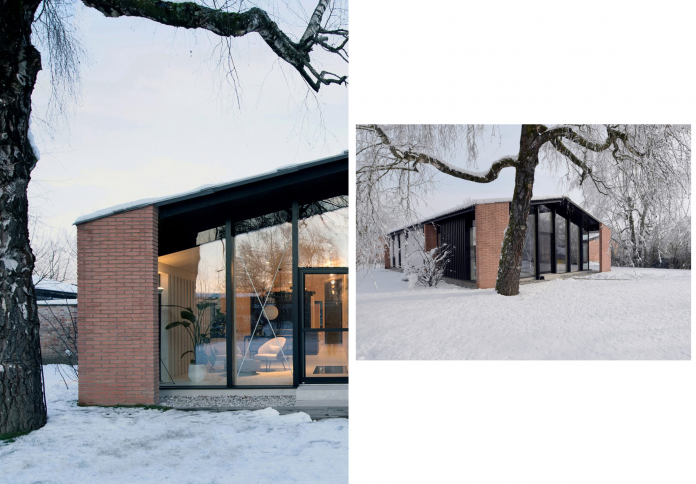
In the verdant landscape of Slovenia, where the echoes of post-war architecture still define much of the suburban fabric, Ljubljana-based studio OFIS Arhitekti has completed a project that is both a rescue mission and a reimagining. “House Under the Poplars” is a sensitive reconstruction of a historic 1950s home that had fallen into deep disrepair. Rather than erasing the past to make way for a contemporary statement, the architects chose a path of “critical preservation.” By retaining the original footprint and key structural logic while injecting modern materiality and light, OFIS has created a residence that honors the memory of the site while addressing the needs of a new generation. It is a house that stands as a bridge between the humble functionalism of the mid-20th century and the sophisticated transparency of the 21st, proving that history is not a static relic but a living foundation.
The Art of Surgical Reconstruction
The original structure was a modest, post-war dwelling typical of the region—sturdy but cramped, and suffering from decades of neglect and moisture damage. OFIS Arhitekti approached the project with a “surgical” mindset, identifying which elements contributed to the home’s character and which were obsolete. The architects decided to maintain the primary volume and the pitched roof silhouette, which were essential for the home to remain in harmony with its neighbors. However, the interior was completely gutted and the structural core reinforced to allow for a more open, fluid plan that contradicts the traditionally compartmentalized rooms of the 1950s.
Externally, the house was reclad in a skin of dark, vertical timber slats, a choice that both modernizes the aesthetic and allows the building to recede into the shadows of the tall poplar trees that give the property its name. This dark “envelope” is punctured by large, strategically placed windows that frame views of the garden like living paintings. The contrast between the somber, protective exterior and the bright, airy interior is a hallmark of the design, creating a sense of drama and discovery as one moves from the street into the private sanctuary of the home.
Light as a Structural Element
If the original house was defined by its enclosure, the reconstruction is defined by its permeability. OFIS Arhitekti utilized light as a primary building material, creating a double-height living area that serves as the heart of the home. By removing parts of the first-floor slab, the architects allowed southern light to penetrate deep into the ground floor, illuminating the exposed concrete and warm wood finishes. A sculptural, open-tread staircase connects the levels without obstructing the visual flow, further enhancing the sense of boundless space within a relatively small footprint.
The material palette is a refined mix of the “raw and the cooked.” Polished concrete floors provide a cool, industrial base, while built-in furniture made of local oak adds a layer of domestic warmth. This juxtaposition pays homage to the site’s history—referencing the utilitarian materials of the post-war era—while elevating them through contemporary detailing. Every surface is designed to catch the shifting patterns of light filtered through the poplar leaves, ensuring that the atmosphere of the house changes constantly throughout the day and the seasons.
Integration with the Poplar Grove
The relationship between the house and its namesake trees is not merely poetic; it is fundamental to the home’s thermal and emotional performance. The tall poplars act as a natural screen, providing shade during the hot Slovenian summers and allowing low winter sun to warm the interior once the leaves have fallen. OFIS Arhitekti extended the living space into the garden via a series of tiered wooden terraces that blur the line between architecture and landscape. These outdoor rooms allow the residents to live “under the poplars” in a literal sense, fostering a deep connection with the local ecology.
Sustainability was also a core pillar of the reconstruction. By choosing to renovate rather than demolish, the project significantly reduced its carbon footprint. The new envelope features high-performance insulation and triple-glazed windows, while a geothermal heat pump provides efficient climate control. The project demonstrates that the most sustainable building is often the one that already exists, provided it can be adapted to meet modern standards of energy efficiency and comfort.
A Model for Suburban Renewal
“House Under the Poplars” serves as a compelling model for how to deal with the aging housing stock of Europe’s post-war suburbs. Many of these homes are reaching the end of their functional lives, yet they possess a scale and character that is often lost in new developments. OFIS Arhitekti has shown that through thoughtful intervention, these “anonymous” houses can be transformed into world-class architecture without losing their soul. The project is a celebration of the “ordinary,” proving that with creativity and respect, even the most humble structure can be given a second, more brilliant life.
Ultimately, the success of the house lies in its quiet confidence. It does not shout for attention; instead, it waits to be experienced. It is a home that values the rustle of the wind in the trees and the play of light on a concrete floor above all else. In “House Under the Poplars,” history and modernity do not just coexist—they dance, creating a space that is as timeless as the landscape it inhabits.