As we move into 2026, the lush, mist-shrouded slopes of northeastern Türkiye are no longer just a local secret—they have been crowned one of National Geographic’s “Best of the World” destinations. While the country’s southern turquoise coast has long drawn the crowds, the Black Sea region offers a verdant, cooler alternative where life moves at the pace of a simmering kettle. In the provinces of Rize and Artvin, the landscape is a rolling mosaic of “emerald-green” tea plantations that cling to impossibly steep mountainsides. Here, the ritual of “çay” (tea) is the heartbeat of every village, a symbol of radical hospitality that turns every traveler into a guest. For those seeking the “soul” of Turkish culture, a trip to the tea capital is a sensory immersion into a world where “green gold” is both an economic lifeline and a daily prayer.
The Tea Capital: Rize’s Vertical Harvest
Rize is the undisputed center of Türkiye’s tea universe, responsible for nearly 70% of the nation’s production. Unlike the massive corporate monocultures found in other parts of the world, the tea gardens here are predominantly small, family-owned plots passed down through generations. The harvest is a grueling, hand-crafted labor of love; because the slopes are too steep for heavy machinery, the local people—often the women of the community—navigate the terrain with wicker baskets strapped to their backs and heavy shears in hand.
In 2026, tea-harvesting tours in villages like Çeçeva have become a hallmark of the region’s “regenerative tourism” push. Visitors are invited to step into the rows of tea bushes, learning the precise “two leaves and a bud” technique that ensures the highest quality brew. This hands-on experience bridges the gap between the consumer and the land, highlighting the resilience required to cultivate crops in a region where the geography is as challenging as it is beautiful. In Rize, tea isn’t just a plant; it is the architect of the social and physical landscape.
Omotenashi in a Tulip Glass: The Ritual of Serving
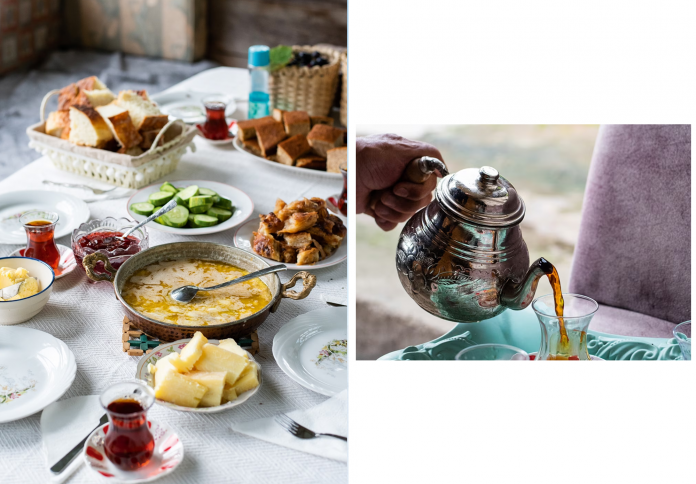
In the Black Sea region, “çay” is the universal language of welcome. It is never “just a cup of tea”; it is a memory, a conversation, and a community steeped slowly and shared endlessly. Traditionally served in a small, tulip-shaped glass (ince belli), the tea’s deep, ruby-red color—often described as tavşan kanı or “rabbit’s blood”—is as much a part of the experience as the flavor itself. The clear glass allows the drinker to appreciate the clarity and warmth of the infusion before the first sip.
The preparation is a ritual of patience, utilizing the çaydanlık, a unique double-decker teapot. The lower pot boils the water while the upper pot holds a concentrated tea essence, gently warmed by the steam below. This dual system allows for complete customization: koyu for those who prefer a dark, robust hit, or açık for a lighter, more refreshing brew. In 2026, the “slow tea” movement has taken root here, encouraging travelers to sit for hours in local tea houses (çay evi), where the kettle is never empty and the conversation never ends.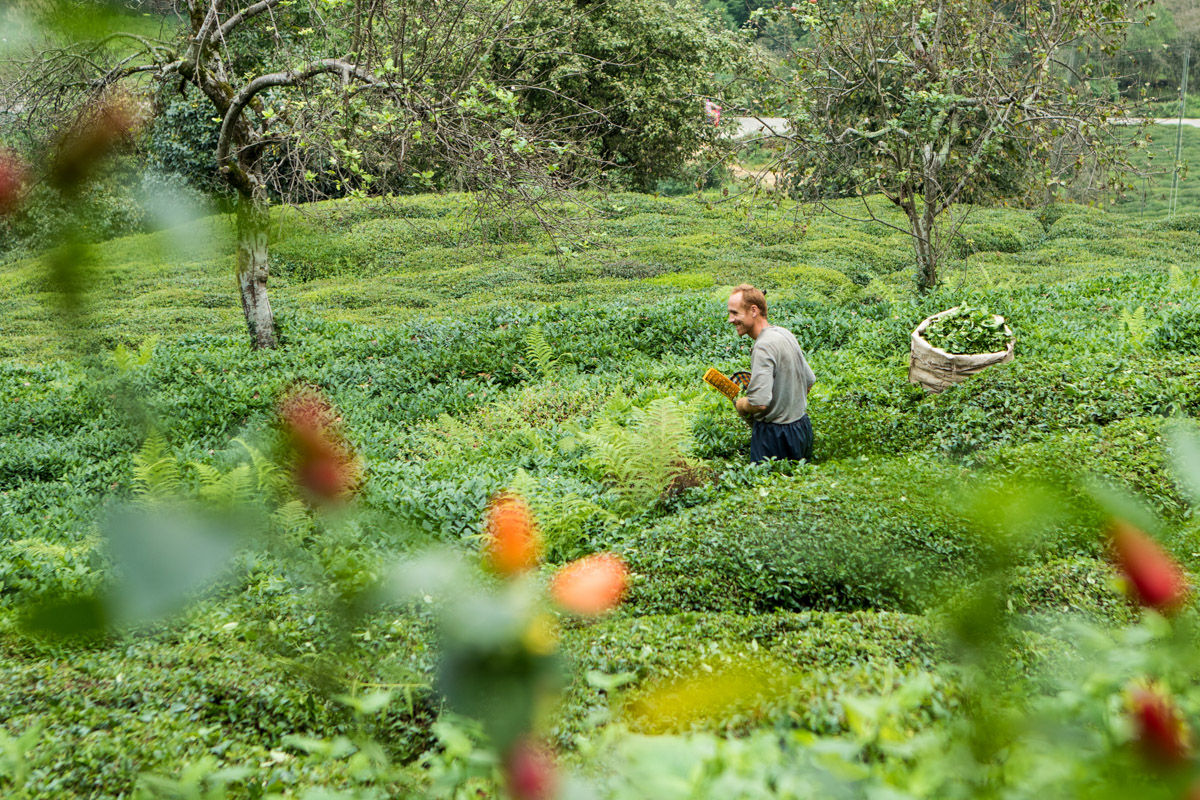
The Hemshin Heritage: A Culture Woven in Wool and Tea
Deep in the Fırtına Valley and the surrounding hamlets like Ortaköy, the tea culture is inextricably linked to the Hemshin people. Known for their distinct traditional dress—colorful, hand-woven scarves often decorated with silver trinkets—the Hemshin are the stewards of some of the region’s most remote plantations. Their wooden homes, perched high above steep ravines, are often accessible only by primitive cable cars used to transport both tea bundles and people across the misty voids.
For the Hemshin, tea time is often accompanied by local delicacies like muhlama—a rich, decadent fondue made from cornmeal, local butter, and stringy cheese. Sitting in a mountain village, watching the clouds roll through the valley while sipping tea and eating muhlama, offers a glimpse into a lifestyle that has remained remarkably untouched by the frantic pace of modern Istanbul. This cultural richness is what makes the Black Sea coast a “spiritual alternative” to the typical Mediterranean holiday, offering a connection to ancestral traditions that are still very much alive.
The Bio-Diversity of the North: Organic and Pesticide-Free
One of the most significant pride points for Black Sea tea producers in 2026 is its “natural and organic” status. Because the region experiences snowy winters, the tea plants are naturally protected from pests that plague warmer climates, allowing for production without the use of chemical pesticides. This makes Turkish tea from Rize and Artvin some of the most “pure” in the global market. Scientists and tea connoisseurs alike are increasingly drawn to the region to study how the unique microclimate—cool summers and high precipitation—creates a flavor profile that is smooth, robust, and less astringent than its Asian counterparts.
Beyond the plantations, the region is a symphony of biodiversity. In places like Borçka Karagöl Nature Park, the tea fields eventually give way to dense forests and crystalline “black lakes” that reflect the surrounding granite peaks. This intersection of agriculture and wilderness is what National Geographic highlights as the region’s greatest asset. Travelers in 2026 can spend the morning harvesting tea and the afternoon hiking through ancient forests, proving that on Türkiye’s northern coast, the “green gold” of the hills is just the beginning of the treasure to be found.