India’s gem and jewelry industry, long regarded as a global powerhouse in design and manufacturing, is facing renewed pressure as exports and imports sharply decline. With mounting tariffs, softening global demand, and persistent geopolitical instability, the country’s once-robust trade figures are showing signs of strain—prompting concern and recalibration across the sector.
A drop in exports and imports reflects mounting global pressures and trade uncertainties
India’s gem and jewelry industry, a cornerstone of its export economy, is feeling the weight of global turbulence. According to the Gem and Jewelry Export Promotion Council (GJEPC), April 2025 saw a 5 percent year-over-year decline in overall gem and jewelry exports. While many factors contribute to this downturn, industry leaders point primarily to international tariffs and persistent geopolitical tensions.

The numbers are not only a snapshot of market performance but also a reflection of the global uncertainty currently clouding trade and supply chains. Imports also took a significant hit, dropping by 18 percent compared to April last year, underscoring a sluggish market responding to fluctuating demand and high policy barriers.
Trade policy and global tension drive disruption
Colin Shah, managing director of Indian manufacturer Kama Jewelry and former chairman of GJEPC, highlighted tariffs—particularly those linked to U.S. policy under President Trump—as a key factor in the industry’s April decline. “The exports witnessing a decline in April 2025 can be viewed as a direct impact of the tariffs levied by President Trump, which have shaken the global market, thereby creating a ripple effect in the domestic market as well,” Shah noted.
This comment speaks to the broader trade landscape in which India’s export-heavy jewelry sector operates. The U.S.-China trade conflict, once the centerpiece of global economic tension, remains unresolved and volatile. Despite recent moments of de-escalation, its lingering effects continue to be felt throughout Asia’s manufacturing hubs.
Additionally, prolonged conflicts in the Middle East and the ongoing war between Russia and Ukraine are contributing to instability in both supply chains and consumer sentiment. “The prolonged geopolitical tensions in the Middle East and Russia-Ukraine and the U.S.-China trade war continue to spread a wave of uncertainty across the globe,” Shah said, “thereby impacting the supply-demand dynamics.”
Export performance reflects market softness
India’s gem and jewelry exports totaled $2.04 billion in April, compared to $2.14 billion in April 2024. This 5 percent decline may appear modest, but it represents a continuing trend that has seen the industry struggle to regain pre-pandemic momentum. In particular, diamonds—a product category that often serves as a bellwether for luxury goods—showed notable weakness.
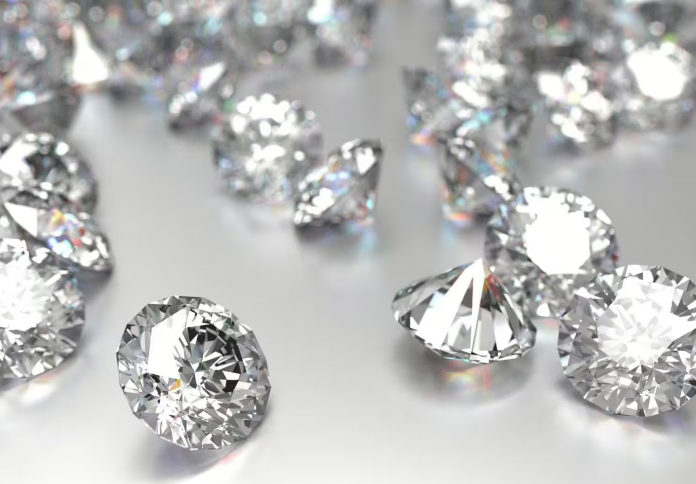
Exports of cut and polished diamonds, one of India’s most prominent jewelry segments, fell by 6 percent year-over-year to $1.12 billion. The decline is consistent with a broader softening in global demand for diamonds, driven by shifting consumer behavior and ongoing concerns about economic stability in major markets like the United States and Europe.
Moreover, the industry is still grappling with the consequences of lab-grown diamonds, which have disrupted traditional pricing models and altered the competitive landscape. Although not directly addressed in this month’s figures, the impact of this growing segment is widely acknowledged among manufacturers and exporters.
Import decline signals weakened domestic demand
On the import side, the drop was even more pronounced. India imported $1.57 billion worth of gems and jewelry in April 2025, down from the same month the year prior by 18 percent. The sharpest decline was seen in the import of rough diamonds, which fell a staggering 46 percent year-over-year to $47.6 million.
Such a steep fall points not only to lower foreign demand for Indian-crafted jewelry but also to a cautious domestic manufacturing sector that appears to be limiting new orders in anticipation of further market volatility. This contraction in imports also suggests manufacturers are opting to rely more heavily on existing inventory or are facing tighter credit and operational constraints.
While April is traditionally a quieter month for jewelry demand—falling between major global buying seasons—the breadth of the import and export declines suggests broader issues at play. The numbers reflect an industry recalibrating itself amid rising protectionism, currency fluctuations, and an unpredictable geopolitical environment.
A cautious path ahead for exporters
Despite the downturn, industry leaders remain cautiously optimistic. Many see the current challenges as part of a cyclical correction rather than a permanent shift. The Indian jewelry sector has proven resilient in past crises, bouncing back from global recessions, currency devaluations, and even the impacts of COVID-19. But with so many macroeconomic variables in play, recovery timelines remain uncertain.
To stay competitive, Indian exporters are likely to continue investing in new product categories, including lab-grown diamonds and high-end bespoke jewelry. There is also increased interest in alternative export destinations beyond traditional Western markets, with Asia and the Middle East emerging as vital regions for future growth.
Furthermore, trade organizations like GJEPC are expected to advocate more aggressively for governmental support, including relaxed tariff structures, incentives for exporters, and investments in marketing initiatives to boost India’s global brand as a jewelry manufacturing powerhouse.
Summary of april’s performance
Exports (april 2025): $2.04 billion
Exports (april 2024): $2.14 billion
Year-over-year change: -5 percent
Cut and polished diamond exports: $1.12 billion (-6 percent)
Total imports: $1.57 billion (-18 percent)
Rough diamond imports: $47.6 million (-46 percent)