From 3D-printed lighting to modular furniture, students at Thomas Jefferson University are reimagining the future of design through experimental materials, real-world collaborations, and thoughtful craftsmanship. This showcase of student projects from the School of Design and Engineering spans a wide range of applications—from healthcare to home interiors—highlighting the creativity and ingenuity of the next generation of industrial designers.
Designing for versatility: Furniture with purpose and innovation
Several of the university’s student projects begin with a classic material wood and elevate it through craftsmanship and clever mechanics. Sam Dorvil’s Folding Bench exemplifies this approach. Created from oak and joined using simple domino joinery, the bench’s structure folds effortlessly thanks to magnetic catches and steel pivot rods. Its practical design makes it ideal for compact living spaces, where portability is key.

Meanwhile, Textile Bench by Skylar Strouss—who studies textile design—combines solid oak with a 50% recycled polyester jacquard fabric. Inspired by bridge construction, the bench explores the tension between softness and strength, form and function. Strouss’s work also represents a broader initiative at the university to bridge textile and furniture design through interdisciplinary projects.
Adaptive solutions for modern workspaces
In response to the ever-evolving needs of offices and educational spaces, Jeifer Perez’s Flujo Screen System introduces a modular room divider that balances form and flexibility. Drawing inspiration from architectural motifs like rhythm, light and materiality, the panels can stand alone or flow together to create dynamic spatial experiences.
Designed as a hypothetical product for furniture company Stylex, Flujo embodies a contemporary design ethos: one that values adaptability, user interaction and aesthetic fluidity. The system offers a way to break up monotonous layouts and reintroduce a sense of movement into static spaces—whether in an office or a university.

Modular storage and meaningful craftsmanship
Architecture student Polina Filipova brings her background in spatial design into the furniture studio with her Modular Storage project. Constructed from chunky oak beams and delicate stretched yarn, the design balances heaviness and lightness in both form and function. Though new to woodworking, Filipova embraced hands-on making, channeling skills passed down from her cabinet-maker father. The piece invites viewers to think about containment and openness—how furniture can both hold and reveal space.
In another exploration of joinery and production efficiency, Shrey Panchal’s Coffee Table uses half-lap cross joints to create structural strength and visual interest. Designed for efficient manufacturing, the table is composed of just a few repeating parts, all made with a single jig. This makes it not only elegant but also scalable, ideal for batch production.
Designing for inclusivity in healthcare
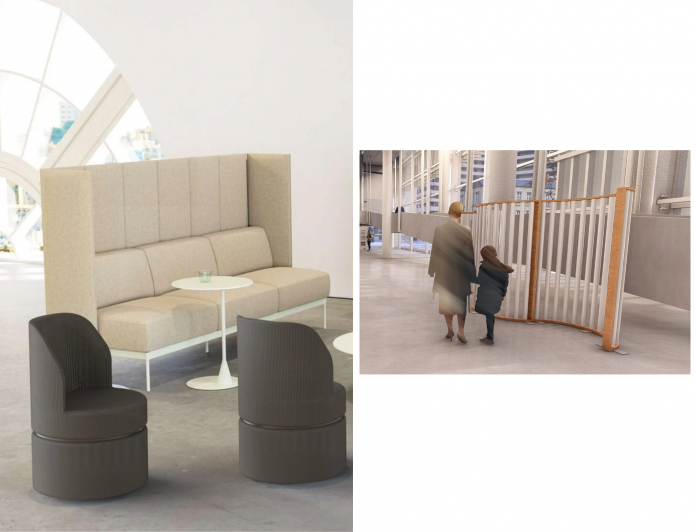
One of the most impactful projects to emerge from the program is the Sensory Seating system, developed in collaboration with Jefferson Health, MillerKnoll and the Jefferson Center for Autism and Neurodiversity. Designed by Elijah Jones, Isaac Savinese, Rachael Hannah, and Nick Galie, the project involved rethinking waiting room seating to better serve individuals with autism.

After prototyping and testing with focus groups of neurodiverse individuals, the team created seating that incorporates wrap-around screens for enclosure and wide, textured armrests for comfort and sensory focus. The final design was so successful that MillerKnoll manufactured and installed it at Philadelphia’s new $762 million Honickman Center, demonstrating the real-world impact of empathetic, inclusive design.
Light, materials, and the future of fabrication
Lighting design is another strong focus at Thomas Jefferson University, with students experimenting in both form and material innovation. Mason Meo’s 3D-printed Luminaires combine digital fabrication with deep material research. With a passion for FDM printing and rapid prototyping, Meo develops lighting designs that explore how process and product intersect, aiming to push what’s possible through new technologies.
Summer Tang’s sophomore lighting project follows a similar path, using clear PET-G material and the Icarus 3D printer at Dive Design to create a lampshade with natural optical diffusion. Rather than fighting the texture of 3D printing, Tang embraces it—turning a functional limitation into a key visual element. Her work reflects a broader trend in industrial design: embracing process as part of the final aesthetic.
A sustainable future with bioplastics
Zachary Dutton’s capstone project takes a deeper dive into sustainability by attempting to solve one of lighting design’s more urgent problems: microplastics. Through more than 200 material experiments, Dutton developed a bioplastic that mimics the properties of acrylic while being biodegradable. The resulting material transmits light, takes pigment well, and can even behave like silicone or rubber depending on its formulation.
This type of experimental work is where design education meets materials science. Dutton’s project, while technical, is rooted in a broader vision: to replace harmful synthetics in product design with responsible, renewable alternatives. It’s a small step toward reimagining not only what we make but how we make it and the long-term consequences of those decisions.
Thomas Jefferson University’s School of Design and Engineering demonstrates how design education can be a platform for meaningful innovation. Whether exploring inclusive furniture, experimental lighting, or modular storage, these student projects reflect a holistic understanding of design—one that values sustainability, inclusivity, craftsmanship, and emerging technology. As industrial design continues to evolve, these young designers are showing the world that good design isn’t just about aesthetics—it’s about intention, impact, and imagining new possibilities.