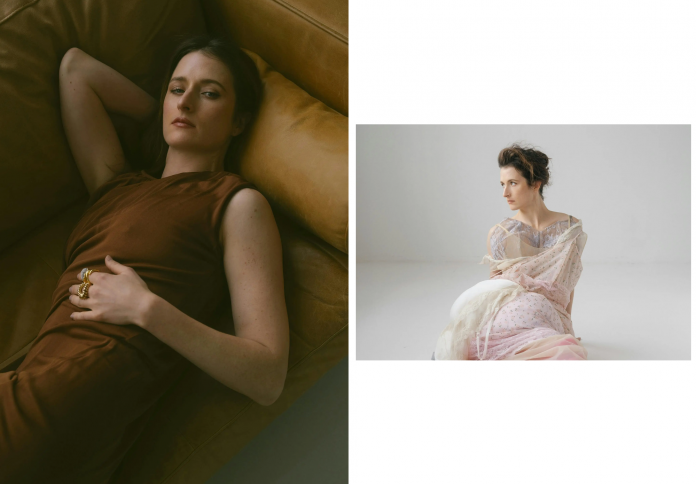
After years of operating blissfully off the digital grid, Grace Gummer is emerging from a period of profound personal transformation into the high-glamour, high-stakes world of Ryan Murphy’s latest anthology. In the upcoming series “Love Story”—a sprawling exploration of the meteoric rise and tragic fall of John F. Kennedy Jr. and Carolyn Bessette-Kennedy—Gummer takes on the role of Caroline Kennedy, the steadfast anchor of America’s most scrutinized dynasty. For the 39-year-old actress, who has long eschewed the Hollywood spotlight in favor of a quiet life in rural Connecticut and now New York, the role is less about the weight of a famous last name and more about capturing the “essence” of a woman who navigated unimaginable loss under the relentless flash of the paparazzi.
The Essence of Caroline: Portraying the Dynasty’s Anchor
In Love Story, which tracks the Kennedy-Bessette romance from their first meeting in 1992 to their 1999 disappearance off Martha’s Vineyard, Gummer’s Caroline Kennedy serves as the emotional and historical counterpoint to the central couple’s chaotic fame. Portraying a living figure she has never met, Gummer focused on the “feeling” Kennedy exudes—a blend of intellectual rigor and private resilience. The actress describes the show as a “love letter,” a necessary romance for a modern world that often feels devoid of such grand, tragic narratives. To prepare, she dove deep into the family’s history, admitting that prior to the project, she had only a limited understanding of the sheer level of scrutiny the couple endured.

Collaborating with Ryan Murphy’s frequent costume designers, Lou Eyrich and Rudy Mance, Gummer worked to perfect the “elevated, classy” aesthetic that defined Caroline Kennedy in the 1990s. The process was deeply personal; Gummer even integrated her own luxury staples—including suede loafers from The Row and a Cartier diamond necklace—into the character’s wardrobe. This blending of the actor’s personal style with the subject’s historical silhouette creates a portrayal that feels lived-in rather than costumed. For Gummer, the role is a tribute to a woman she admires as a diplomat, attorney, and mother—a protagonist who has overcome the “American royal” label to achieve a lasting, independent legacy.
Nostalgia and New York: The Allure of the Pre-Digital Era
A significant draw of the series for Gummer was its setting: the New York of the 1990s. She speaks with a palpable nostalgia for a time “before our phones,” when life was lived moment-to-moment rather than incessantly documented for social media. This period, she suggests, marked the end of a certain kind of creative and artistic freedom in the city. The series captures this vanishing world—the late-night booths at Raoul’s, the intellectual huddles at Film Forum—reminding viewers of an era when the Kennedys were the last vestige of American royalty that the public could genuinely revere.

This connection to the ’90s extends to Gummer’s own wardrobe, much of which consists of pieces inherited from her mother, Meryl Streep, and family friends like the late Carrie Fisher. From a 1990s Armani jacket to a silk jacquard Valentino blazer gifted by Fisher, Gummer’s style is a tapestry of Hollywood history. She admits to a “problem” when it comes to The Row, favoring clothes that are elegant, effortless, and comfortable. This “practical yet chic” philosophy mirrors her approach to her career: a desire for quality over quantity, and a refusal to participate in the “sanity-thieving” comparison culture of Instagram—though she has recently, and somewhat ironically, finally joined the platform to verify her account under her married name, Ronson.
The Ronson Romance: A Modern Love Story
While she portrays a tragic romance on screen, Gummer’s own personal life is a testament to the power of a “real” connection. Since marrying DJ and producer Mark Ronson in 2021 and welcoming two children, she has found a new sense of grounding. Despite her private nature, she is surprisingly open about her devotion to Ronson, stating she will “scream from the mountaintops” her love for him. The couple prioritizes “real conversations” that don’t revolve around sleep schedules, finding sanctuary in the same classic New York spots that defined the era of her show.

This newfound personal stability has allowed Gummer to approach her career with a fresh perspective. Approaching her 40th birthday, she feels “exactly where she is supposed to be,” viewing her thirties as a decade of both extreme hardship and ultimate reward. The dissolution of a past relationship and the building of her current family have “deepened the well,” opening creative doors she didn’t know existed. She no longer views every career setback as a “Greek tragedy,” but rather as a natural part of a path that she is finally navigating on her own terms, separate from the expectations attached to her lineage.
Defining Her Own Path: From Rome to the Lead Role
Gummer’s path to acting was far from linear. After studying art history and Italian at Vassar, she moved to Rome with plans to pursue costume design. It was only when she was asked to design for a play directed by a friend that she realized her true desire was to be “in it,” rather than dressing it. This realization led her back to New York and an internship with Zac Posen before she eventually landed her first Off-Broadway role in 2008. Since then, she has worked steadily to “defy expectations,” proving that while her name might get her in the door, it is her talent and moral soundess that keep her there.

Looking toward the next decade, Gummer’s ambitions are clear: she wants more creative control and the opportunity to lead. “I would really love to be the center of something, the protagonist facing all the adversities,” she says. With her performance as Caroline Kennedy already generating significant buzz, it seems that the “working actor” phase of her career is evolving into something more formidable. Grace Gummer is no longer just a supporting player in a famous family’s story; she is an actress who has found her own voice, her own style, and—most importantly—her own happiness at the center of her own narrative.