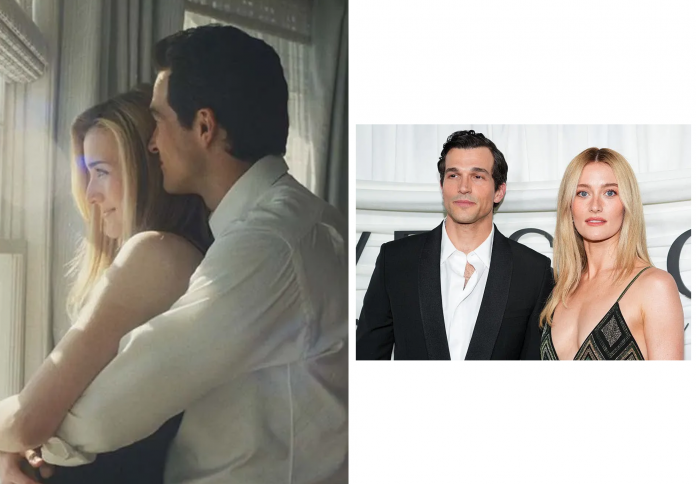
In the fifth installment of Ryan Murphy’s “Love Story,” titled “Battery Park,” the polished facade of America’s most iconic 1990s romance finally begins to splinter. The episode serves as a relentless study of claustrophobia, as Carolyn Bessette (Sarah Pidgeon) is pulled between the corporate demands of Calvin Klein and the archaic, high-stakes rituals of the Kennedy family. Directed with a sharp eye for the “toxic” undercurrents of fame, the episode shifts from the breezy charm of a New York courtship to the heavy, salt-aired tension of Hyannis Port. As 2026 audiences tune in, the series moves beyond the “Golden Couple” myth to explore a relationship struggling to breathe under the weight of an unyielding legacy and a predatory media lens.
Baptism by Fire: The Hyannis Port Initation
The episode’s center of gravity is Carolyn’s first visit to the Kennedy compound in Hyannis Port, a sequence that showrunner Brian Simpson describes as her “baptism by fire.” John (Paul Anthony Kelly) fails to prepare Carolyn for the “unofficial rules” of the house, leading to a series of social landmines orchestrated by the family’s undisputed matriarch, Ethel Kennedy. From being reprimanded for her fashion choices at dinner to the humiliation of failing to navigate the “breakfast board” sign-up system, Carolyn is made to feel like an outsider in a world that demands perfection.
Despite the tension, the visit marks a turning point in her relationship with Ethel. While the early interactions are fraught—with Ethel putting the publicist through an informal political “examination” regarding the federal assault weapons ban—the two women eventually find common ground. Ethel, recognizing Carolyn’s genuine insecurity, offers a rare moment of vulnerability, advising her that the only way to survive the family’s high expectations is to look in the mirror and believe “I’m enough.” This bond foreshadows a protective relationship, with Ethel later serving as a guide for Carolyn as she navigates the transition from private citizen to “the American People’s Princess.”
The Reluctant Proposal: A Boat in the Mist

It is against this emotionally draining backdrop that John chooses to propose. In a scene that captures his “golden retriever” earnestness alongside a profound lack of timing, he takes Carolyn out on a rowboat in Hyannis. Using a metaphor about fishing being “better with a partner,” he asks for her hand, only to be met with a devastating “I need time.” The episode expertly captures the “wind being taken out of John’s sails,” highlighting the growing disconnect between his desire for a romantic milestone and Carolyn’s fear of the “strangling” reality of the Kennedy name.
The narrative deepens as John seeks solace from his sister, Caroline, only to find that she agrees with his partner’s hesitation. The series portrays a rare moment of sibling friction, as Caroline suggests it is too early for marriage, further isolating John in his pursuit of a “perfect” union. When Carolyn eventually agrees to the engagement, she does so with the caveat that they only wear the rings in private—a compromise that feels less like a celebration of love and more like a desperate attempt to maintain a shred of anonymity in an increasingly public life.
Battery Park: The Fight That Became Legend
The episode’s climax is the meticulous recreation of the infamous 1996 public argument in Battery Park (historically Washington Square Park), an event captured by paparazzi and analyzed for decades. The show frames the fight as an inevitable explosion of the pressures mounting throughout the hour: the chaos of the George magazine launch, the betrayal of John’s promise to keep their private lives private, and Carolyn’s feeling of being “on display.” The shouting match—complete with shoving and John’s attempt to remove the ring from Carolyn’s finger—was filmed with such raw intensity that bystanders reportedly called 911, mistaking it for a real dispute.
What distinguishes this dramatization is its focus on the “why” behind the shouting. While the media at the time branded the fight as a sign of a “doomed” pairing, the show suggests it stemmed from Carolyn’s frustration that John allowed people to “walk all over him” for the sake of public relations. By turning the fight into a “consumable event,” the episode raises uncomfortable questions about our own consumption of personal tragedy. It isn’t just a condemnation of the photographers; it’s an acknowledgement of the public demand that turned a private moment of frustration into a national circus.
The Weight of the Ring: Trust and Tabloid Fodder
As the episode closes, the “happy ending” of Carolyn finally accepting the proposal is tinged with a profound sense of dread. The decision is framed not as a triumph of romance, but as a submission to a life where every choice is a headline. The breach of trust—specifically John’s partner, Michael Berman, pushing for a public statement that contradicts John’s promises to Carolyn—creates a rupture that the couple seems unable to fully repair. Carolyn is left watching news coverage of her own life, realizing that her relationship is being reframed as a communications strategy for the Kennedy brand.
The episode leaves the audience with a stark image of the couple in their Tribeca loft: two people who “love hard and fight hard,” yet are increasingly lost in a maze of their own making. Sarah Pidgeon’s performance as Carolyn captures a “fantastically witty” woman who is slowly being replaced by the “Ice Queen” persona manufactured by the tabloids. As they proceed toward their secret wedding on Cumberland Island, the episode makes it clear that while they may have “won” each other, they are rapidly losing the battle for their own identities.