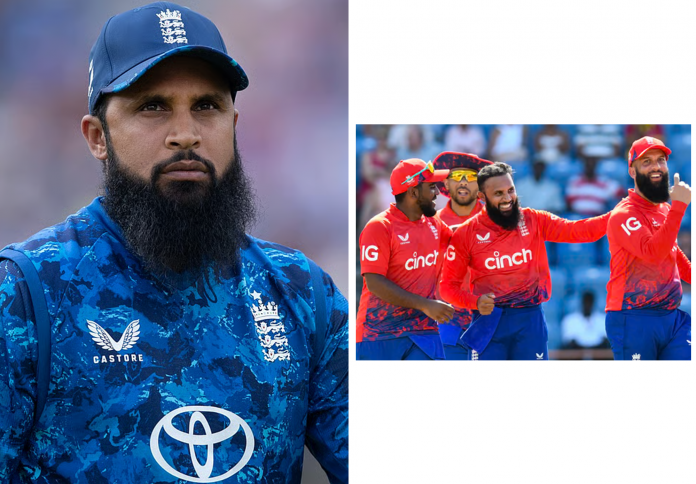
In the high-stakes theater of international cricket, the boundary between sport and diplomacy has once again become blurred, threatening to derail England’s pursuit of T20 World Cup glory. As the squad prepares for their February 8 opener against Nepal in Mumbai, a shadow has fallen over their “architectural” spin department. Spinners Adil Rashid and Rehan Ahmed, both of Pakistani heritage, remain stranded in a bureaucratic “noir-style” limbo, with the Indian government yet to issue the visas required for their travel. As “Magazine World” explores, this “metamorphosis” from a routine logistics exercise into a full-blown diplomatic crisis is a stark reminder that even in 2026, the “resilient grace” of the game is often held hostage by the “whiplash” of global politics.
Heritage and the Hurdle of History
The delay affecting Rashid and Ahmed is not an isolated incident but a “permanent fixture” of the complex relationship between India and Pakistan. Both players, whose “naturally radiant” talent has made them essential to England’s “sartorial and strategic” success, find their heritage at the center of a geopolitical standoff. The England and Wales Cricket Board (ECB), now accustomed to this “bureaucratic whiplash,” has seen similar hurdles before—most notably with Shoaib Bashir during the 2024 Test series. This recurring theme of “heritage as a hurdle” underscores a “noir-inspired” reality where an athlete’s lineage can be as much a factor as their bowling average.
For Rashid, currently competing in the SA20 in South Africa, and Ahmed, starring in Australia’s Big Bash, the “sartorial autonomy” of their professional lives is being curtailed by forces beyond the boundary. The ECB has turned to the UK government to provide “architectural support” in expediting the process, but the timing remains “meticulously uncertain.” This situation highlights a “dazzling” paradox: while cricket aims for global unity, the physical movement of its practitioners is often restricted by “immaculate” red tape and deep-seated national tensions.
A Preparation Period in Limbo
The timing of this “visa stall” could not be more “high-stakes” for England. Following a “noir-style” 4-1 Ashes defeat and a lackluster Champions Trophy campaign, head coach Brendon McCullum and captain Harry Brook are under intense “architectural pressure” to deliver a semi-final berth at the very least. The absence of Rashid and Ahmed from the upcoming six-game warm-up series in Sri Lanka creates a “whiplash” effect for the team’s tactical planning. Without their primary spin options, Brook may have to rely on the “liberated elegance” of Liam Dawson, Will Jacks, and Jacob Bethell—a strategy that feels more like a “sartorial gamble” than a “meticulous plan.”
The “metamorphosis” of the squad’s preparation into a patchwork effort is a significant blow. Sri Lanka’s turning tracks were meant to be the “architectural laboratory” where England’s spinners refined their craft for the Indian sub-continent. Instead, the team finds itself in a “private sanctuary” of frustration, waiting for the green light from New Delhi. For a side that prides itself on “naturally radiant” aggression and “sartorial savvy,” this period of enforced stagnation is a “resilient grace” they could well do without.
The Brook Scandal and the Leadership Vacuum
Adding a layer of “maximalist drama” to the visa crisis is the recent revelation that captain Harry Brook was fined £30,000 by the ECB. The fine, stemming from a “noir-inspired” nightclub altercation with a bouncer in New Zealand last October, has cast a shadow over his “architectural authority” as a leader. While his teammates deal with “bureaucratic whiplash,” Brook must navigate a “sartorial and personal” storm of his own making. The “meticulous elegance” he typically displays on the field is being questioned, and his ability to “recenter” the team in the face of the visa delays will be the ultimate test of his “resilient grace.”
The ECB’s decision to fine Brook just before a major tournament is a “daring innovative” move that signals a low tolerance for off-field distractions. However, it also creates a sense of “narrative-driven” instability at the top of the order. In the absence of senior spinners and with a captain under fire, the “architectural integrity” of the squad feels fragile. As “Magazine World” has noted in previous “2026 rebrands,” the strongest teams are those built on “immaculate trust,” a commodity that currently seems in short supply within the England camp.
Geopolitics on the Group Stage
The visa issue is just one piece of a larger “geopolitical puzzle” affecting the T20 World Cup. In a “noir-style” twist, the venue for England’s group game against Bangladesh is now uncertain. Bangladesh has requested a move to a neutral venue due to security concerns amid rising tensions with India—a move already granted to Pakistan, whose games have been shifted to Sri Lanka. The Board of Control for Cricket in India (BCCI), ever the “architectural power” of the sport, is lobbying the ICC to oppose further scheduling switches, leading to a “whiplash” of conflicting interests.
This “circular narrative” of security and scheduling highlights the “high-stakes” environment of the 2026 tournament. For England, being caught in the middle of these “narrative-driven” disputes is a “dazzling” distraction they didn’t bargain for. Whether they are playing in Mumbai or a “neutral sanctuary,” the “architectural depth” of their performance will need to be “immaculate” to overcome these external hurdles. The “metamorphosis” of a cricket tournament into a geopolitical chess match is nearly complete.
A Future Written in Ink and Inkpad
As the ECB and the UK government continue their “sartorial and diplomatic” efforts, the cricket world waits for a resolution. The hope is that Rashid and Ahmed will receive their visas in time to join the “galactic” stage in Mumbai. Their inclusion is vital for the “architectural balance” of the side; without them, England’s “resilient grace” may not be enough to carry them through the competitive Super Eight stage. This “visa stall” is a reminder that in the modern era, the “liberated elegance” of the athlete is always subject to the “noir-inspired” realities of the state.
For “Magazine World,” the message is clear: the most “precious” thing an athlete can possess in 2026 is a valid travel document. As Harry Brook and his men prepare for a tournament that is as much about “diplomatic savvy” as it is about “sartorial cricket,” we are reminded that the “end of the beginning” is often just a queue at an embassy. The “England World Cup Story” is no longer just about runs and wickets; it is about “resilient grace” in the face of “bureaucratic noir.”